_forumlogo.png.a607ef20a6e0c299ab2aa6443aa1f32e.png)

jeffcrom
-
Posts
11,694 -
Joined
-
Last visited
Content Type
Profiles
Forums
Events
Blogs
Everything posted by jeffcrom
-
Okay, things seem to be deteriorating since I started this thread. I assumed that the Concord put the Sonny Terry album on CDr because it was such a low-demand item, with even less demand than their mainstream jazz issues. Well, I asked my favorite local brick-and-mortar CD store to order me a copy of Jackie McLean's Prestige CD Lights Out. The store owner said that it was backordered, but should eventually come in. It did, after a few weeks, and I picked it up today. It's a CDr. Again, there is no indication anywhere on the packaging that it was anything but a factory-made silver CD. I'm not going to buy any more Concord products anytime soon.
-
Like them both a lot. Me too. Whatever you want to call Evans' piano style, it works well with Konitz.
-
I know that Bev has gone on to installment 17, but there's plenty of interesting items left in #16. "Black Swan" was played during Ellington's 1969 European tour as an encore, and presumably as a chance for most of the brass and reed players to rest. The only issued version I'm aware of is from the Manchester concert that provides the bulk of the 70th Birthday Concert album. It's an interesting tune - Latin-rhythmed and utilizing an attractive, unusual chord progression. The Manchester version is played by a quintet - Ellington, Wild Bill Davis on organ, Norris Turney on flute, bassist Victor Gaskin, and Rufus Jones on drums. Everyone except Ellington gets solos; Turney's flute is particularly impressive, as is the drum solo - Jones concentrates on the cymbals and makes frequent references to the melody, a la Max Roach. "Black Swan" is a good one - I would have liked to hear a full-band version by Ellington.
-
Joe Albany & Niels-Henning Orsted Pedersen - Two's Company (Inner City)
-
crappy sound, great music. Yep - from the first notes my thought was, "Who thought that this was what a piano is supposed to sound like?"
-
McCoy Tyner - Sahara (Milestone)
-
In the end, I guess it doesn't matter what the reason for it was; from the point of view of jazz history, what it led to is the important point, isn't it? MG A timeline from the book Storyville, New Orleans by Al Rose (I'm paraphrasing, not quoting directly): August, 1917: Open prostitution is banned within five miles of any US army or navy installation. A representative of the War and Navy departments tours Storyville and orders Mayor Martin Behrman to close it. September 10: Behrman travels to Washington to protest the ruling, without results. September 24: Secretary of the Navy Josephus Daniels sends a message to Behrman: "You close the red-light district or the armed forces will." October 2: Behrman presents an ordinance to close The District to the City Council. October 9: The ordinance passes, to take effect at midnight, November 12. November 11: Madame Gertrude Dix's request for an injunction blocking the ordinance is rejected by the Louisiana Supreme Court. November 12: Storyville closes, although most of the houses are already closed, and a few madames pay off the police and continue to operate for a time. I think that the notion of a single event scattering New Orleans musicians to other cities is exaggerated, although the closure of The District probably convinced some musicians that it was time to leave. The houses themselves employed piano players (and occasionally string players), not jazz bands. The many bars in The District gave employment to jazz musicians, but there were still plenty of bars and dance halls in the city. The main reason musicians left New Orleans was money. The cost of living was low in New Orleans, and, then as now, there was an over-abundance of musicians, so wages were low. Word got out that a musician could make far more in California or Chicago, so musicians went where the money was. Of course, life was attractive enough in New Orleans that plenty of good musicians stayed - the myth that all the good players left and only the inferior one stayed doesn't hold up to much scrutiny. The unrecorded Buddy Petit and Chris Kelly were considered by many to rival Louis Armstrong and King Oliver in ability, for instance.
-
Que es? Yes, I wondered, too... MG It's cool, is what it is - lap steel-playing bluesman Freddie Roulette playing instrumental R & B in LA, 1973. It was produced by Harvey Mandel, who plays on a couple of tracks. Among the other sidemen are Sugarcane Harris and Victor Conte, who played bass with Tower of Power and later became a "sports nutritionist" who helped lots of athletes with their doping. Now playing: Horace Silver - Blowin' the Blues Away (BN UA dark blue label)
-
 Right - but my point was that I don't don't know much about Statman's chronology (and am not interested in finding out more) because I don't find his music compelling. And my "pre-Byron" list was is certainly not (and is not intended to be) exhaustive - it was just some evidence of pre-Byron klezmer revival activity that come to mind quickly.
 -
The Byron/Klezmatics connection goes back further than that - Byron and Frank London were bandmates in the Klezmer Conservatory Band. And for all I know, the boys and girls of The Klezmatics may have loved Byron's klezmer album. I still don't. And Andy Statman is not really on my radar, because I'm bored by everything I've heard by him. I have no doubt that you're right, though.
-
Freddie Roulette - Sweet Funky Steel (Janus)
-
Thanks, Chuck - figured you would know. Now playing: Karl Berger - Tune In (Milestone). Great band - Berger, Carlos Ward, Dave Holland, and Ed Blackwell.
-
The UK version is just fine . During what period did Decca use this method of production.? All the ones I have are from 1954-56. I've seen some similar squeezings on some discount labels (and the Tony Aless Roost LP I recently posted about), but Decca/Brunswick was the only major label I know of who tried this. I guess it seemed like a good idea at the time. Now playing: Paul Bley - Barrage (ESP). Mine has the red cover (and labels) as shown, rather than the more common black. I think it's the original issue - someone correct me if I'm wrong.
-
Another spin of this excellent and intriguing album. Given how it looked when I bought it, I'm still amazed at how relatively good it sounds.
-
Ripping the Membran JATP box
jeffcrom replied to The Magnificent Goldberg's topic in Mosaic and other box sets...
I've got that Asch 78 album, and posted the question of CD reissue - probably two years ago. Someone (King Ubu?) said that those Asch sides were on the Verve Complete Early JATP box, even though they didn't come out on Mercury at the time. I don't have time to look for that thread right now. -
The interesting segment quoted by Jim aside, this article kind of grated on me. Byron's Mickey Katz album always seemed like a bad joke to me - for musical reasons, not sociological ones. By the time it came out in 1993, the incredibly inventive Klezmatics had issued two albums, and more traditional but excellent Klezmorim had put out six. Ben Goldberg is a far more interesting clarinetist than Byron; his New Klezmer Trio issued their first album three years before Byron's. I just don't think Byron's klezmer stuff was nearly as influential as he and the article's writer think. In my circle of musical friends, The Klezmatics was the band that excited us. We all thought the Byron album was pretty silly. On the other hand, Byron's Tuskegee Experiments was a striking debut. I wish Byron's later work had fulfilled the promise of that album.
-
I like the vaguely insulting sound of "squeezing" better myself. Now spinning another plastic squeezing, which I just came across a couple of days ago. It's pretty beat, but with a mono cartridge sounds better than it has any right to: Tony Aless - Long Island Suite (Roost). I was totally unaware of this 1955 album, but it's good. Nick Travis, Dave Schildraut, Billy Bauer are on hand, as are trombonists "Moe and Joe" - aka Jay and Kai. It has had a Japanese EMI CD issue, but otherwise has resisted digitization.
-
I now realize that I know only a fraction of his output. RIP
-
John Graas - Jazz Lab 1 (Decca). Unfortunately, a really terrible... I was going to say "pressing," but it's not vinyl - it's one of those Decca injection-molded plastic records. What would you call that - a "squeezing?"
-
Inspired in part by MG's scientific inquiries: Rock and Rollin' with Fats Domino (Imperial). A nice deep groove original pressing of Fats' first US album, found about 15 years ago for a couple of bucks.
-
Bud Shank Quartet Featuring Claude Williamson (PJ)
-
Kenton Presents Boots Mussulli (Capitol) Edited to add that the cover photo drives me crazy. I spent 29 years teaching students not to hold saxophones by their necks.
-
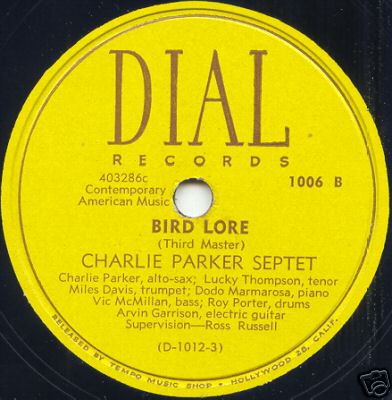
I've got, I think, four sides (on three 78s) by Rosa (aka Rose), and like her music quite a bit. Glad you found her. I just bought a lot of nine records, one of which checks an item off my want list that I thought might never find. I played all the modern jazz from the lot today: Dodo Marmarosa - Mellow Mood/How High the Moon (Atomic, 1946). I already had a copy of this, but I picked this one up anyway, because it looked to be in significantly better shape than my copy. It really doesn't sound any better, though. But it's a great record. Tempo Jazz Men featuring Gabriel on trumpet (Dizzy Gillespie) - Dynamo A/Dynamo B (Dial, 1946). I've been listening to Dizzy for almost 40 years, and I had never heard the "B" master of this tune (aka "Dizzy Atmosphere") until today. Tom Archia - McKie's Jam for Boppers/Downfall Blues (Aristocrat, 1947/48). Nearly as cool as my "big" find. Which is: Andrew Hill Combo - After Dark/Down Pat (Ping, 1956). With Von Freeman, Pat Patrick, Malachi Favors, and Wilbur Campbell. The 45 RPM issue of this is rare, but seemingly findable with patience. I have never seen a picture of the 78 and never seen it for sale until I found this one. I'm pretty tickled. And Von absolutely kills.
-
Increasing speed of records half a tone
jeffcrom replied to The Magnificent Goldberg's topic in Miscellaneous Music
The Magnificent One asked me if I had anything to contribute to this thread. Not much, but: My mid-50s copy of Fats' first US LP, Rock and Rollin' with Fats Domino, has "The Fat Man" playing in F sharp, which is kind of ridiculous. Fats played it in F, I'm sure. Look at MG's original post - the difference in the percentages between half steps doesn't show up until the third decimal point. Those differences are far too small for us to hear. Before I put on the Fats LP, I had a Gary Burton LP on the turntable. The first tune was "Green Dolphin Street" in E flat. When I put the speed control on 45, it put the tune in A flat (more or less). The instruments sounded funny, off course, but the pitch relationships were just fine - all of Burton's keys were perfectly in tune with each other. -
Well, there is something of a "war on music" going on in New Orleans right now - led, as far as I can tell, by residents who moved into neighborhoods that already had bars with music. But, yeah - the article is kind of over the top. The closing of Donna's and the Funky Butt had more to do with landlord issues (both buildings were owned by the same person), exacerbated in the former case by Charlie's (Donna's husband) health and in the latter case by Katrina. The link in the article refers to a short-lived attempt to revive Donna's (which I was not even aware of). It sounds like the new owners were not the good neighbors that Donna and Charlie were. But it's a real issue down there - gentrification is not always a good thing.