_forumlogo.png.a607ef20a6e0c299ab2aa6443aa1f32e.png)

JSngry
-
Posts
86,191 -
Joined
-
Last visited
-
Days Won
1
Content Type
Profiles
Forums
Events
Blogs
Everything posted by JSngry
-
Got a copy today, listened once. Very much like Oliver's charts, really interesting use of an interesting instrumentation. Also like the rhythm section, although I do feel a little groove-whipped by the end. But as an LP, one side at a sitting seems like it would have been, uh, groovy. But...If I could get a karaoke mix of this album, that would be great. Herbie Mann is superfluous on his own record, imo. OTOH, he's the reason the record got made, so c'est last vie. And for the time it stays a ballad, I do like the way he plays the melody on "Yesterday". On balance, glad to have gotten it, Oliver's charts consistently pique the ear, and the Ellington tunes foreshadow his later 3 Shades Of Blue album.
-
whaaaaaat?
-
Gershwin don't even know his own changes!
-
Produced by Cedar Walton.
-
The Joint Chiefs Of Staff The Iron Chefs The Musical Chaloffs
-
Fresh, still fresh fresh fresh.
-
My back cover is totally blank.
-
woah....RIP
-
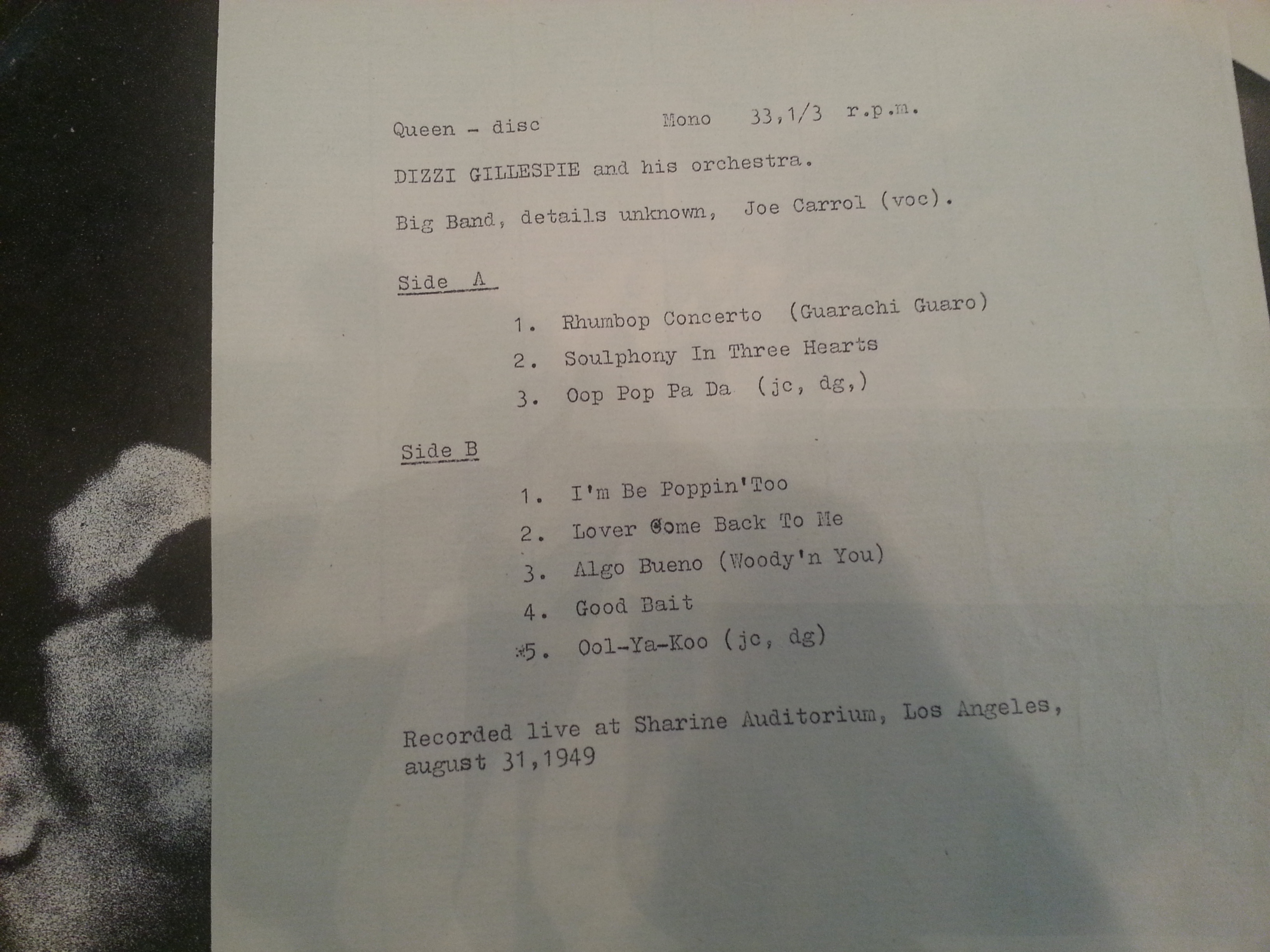
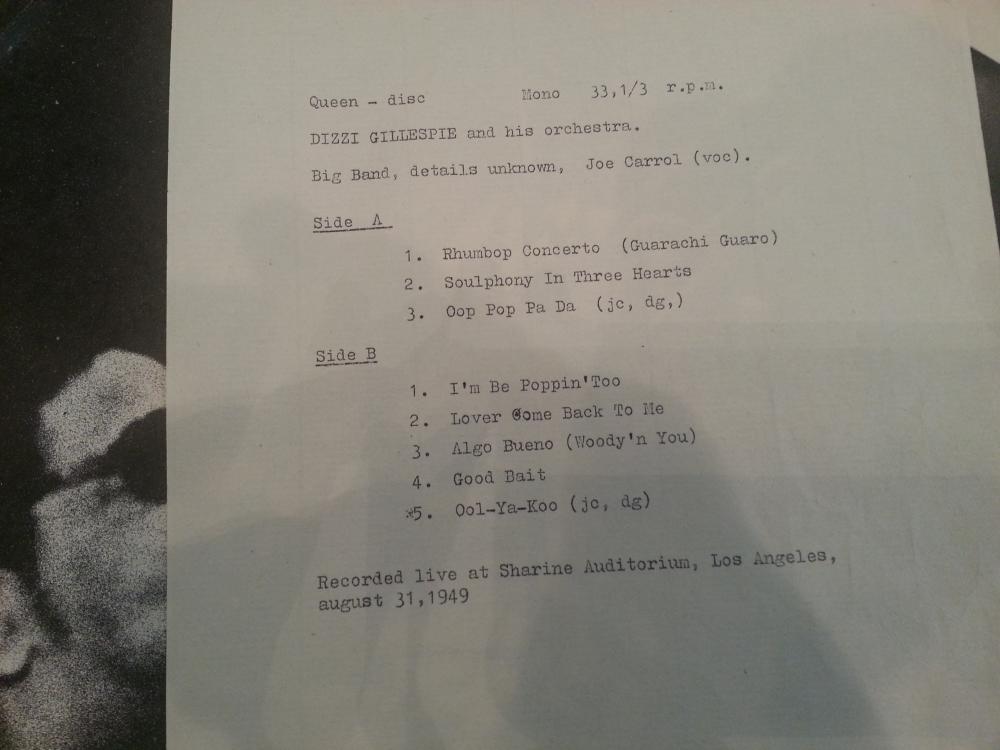
Does this come through? Sorry, scanning to computer not an option right now, just phone pix
-
Yeah dude, keep on walking, that church has Chet Atkins inside it. Find the one where Hovie Lister goes...oh, you say that's a picture of you leaving the session...ok, never mind then, have a nice day, jesus loves you anyway, and I know that Chet made some interesting production choices. But next time, find Hovie Lister.
-
That both looks and sounds right, thanks!
-
The New York Saxophone Quartet (jazz-classical) - 20th Century Fox Records, 1964. Quartet composed of Ray Beckenstein, Eddie Caine, Al Epstein, & Danny Bank. Compositions by Genes DiNovi & Orloff, George Handy, Manny Albam, a.o. Pretty interesting record. Nice to hear those kinds of tones and pulses playing this kind of music...or is it that those kinds of tones and pulses are what makes this kind of music? Either way, fun record.
-
Muse, High Note, etc.
-
Interesting to hear how the different recording strategies and, I suspect, the presence or absence of a few particular section players affect the immediate "Oliver Nelson-ness" of Oliver Nelson's charts, which are all pretty interesting, especially the introduction to "Street Of Dreams".
-
Now can the secret to that piano sound be revealed?
-
End of more than an era. RIP
-
The lp contains a typewritten page with tune titles, blahblah and "Recorded live at Sharine Auditorium, Los Angeles, August 31, 1949"...yes, it says "Sharine" instead of Shrine, oh well. It also confirms Joe Carrol'presence, but gives no other personnel. Has any refinement of the personnel come about since this record first came out? The recording over skews the balance towards the rhythm section and away from the band, but that's ok, since the rhythm section is really dealing. Finally, has this seen a couple release of any kind? As always, thanks in advance. Brief tenor solo sounds like it might be Yusef?
-
Death of the iPod (Everyone's buying vinyl)
JSngry replied to A Lark Ascending's topic in Audio Talk
God, I'd hate to live in a town where you couldn't walk down the street without everybody endlessly gabbing, especially if they feel a need to include me because I look disengaged or something. I have a podcast to listen to, dammit. -
Earl May Earl Grey Earl T. Shinhoster
-
Death of the iPod (Everyone's buying vinyl)
JSngry replied to A Lark Ascending's topic in Audio Talk
If they're part of a community that listens to the same podcast, then they're not really disconnected unless they never do anything else or never interact with anybody else. I know there's people like that, but they're not likely to be the type that go places, even if they listen to their podcasts en route. Perhaps you'd prefer a return to boom boxes? -
The way I had it taught to me was that you could take any note from an original chord, and then use that as a root for any other quality chord. You just needed a note (or a tritone sub of a note) from the original chord. Davids Baker and Liebman both taught this. Baker talked about George Russell's theory of note gravity, or whatever it was called, how every note has some kind of gravitational pull towards every other note, Liebman basically name-checked Bartok and let it go at that, but in both cases the gist of the matter was that anything can follow anything, notes or chords, so it's on you to provide the logic. If the logic is using major 7th chords as your "color" and you put your color into a symmetry that fits the space, then you have essentially chosen the color for the room, if you know what I mean.
-
And that's exactly why it works, you have a stated starting point, an expected ending point, and a symmetry that gets you there in the allotted space. Same reason why you can put (and Trane did put) "Trane changes" into seemingly any standard song form. The math works, you have four "landing points" and eight bars. And there's the whole thing about diminished chords (and scales) theoretically having multiple possible key centers because of the lack of a clear-cut Tonic/Dominant relationship. A basic tritone interval, without context, could, in basic diatonic harmony, have one of two key centers (cf "Blue Seven" for an overt exploitation of this ambiguity, I know you've read Schuller's breakdown of the maths about that) ). A diminished chord, consisting of two tritone intervals at once, then has double the possible key centers, four. So if you keep that symmetry, four possible key centers, eight bars, smooth. This movement, C7/Db7/D7/Eb7 substitutes for the traditional (in Ab) movement of C7/F7/Bb7/Eb7, only the middle two chords are changed. There's a symmetry there, too, because replacing the F7 with a Db7 is based on substituting down a major 3rd and substituting Bb7 with D7 is based on substituting up a major third. Cosmic, right? Or not.... But now you gotta ask is any form that is 32 bars in length and spends the a-sections moving around back into itself and then goes to the III7 chord for an 8-bar bridge before coming back in on itself to repeat the final A is in fact "rhythm changes"? I suppose it is, but if then the thing I wonder about is at what point does the symmetry become a reflex and/or "crutch" rather than a "natural" creative occurrence. I don't know, I'm not qualified to have an answer to that one, not really sure if I'm qualified to ask it...but it does get asked. Final thing - once you get away from "circle of fourths" type thinking (and American Pop composers would occasionally do it, my rule of thumb for faking a standard with that everything was going to be essentially diatonic to the key, and if you heard anything that sounded "surprising", it was the key center changing a 3rd, and I learned the once-frightening "Ipanema" bridge to actually be easy once you learned the math/symmetry/formula, whatever, any key, it sounds a lot more "difficult" than it really is, it's math, the changes, anyway, math is not music, but harmony itself sure as hell is math) the same sort of thing happens as when you start getting away from triadic harmony - more spaces open up, getting from one point to another no longer is as automatic a route as it once was, there is definitely more "freedom" available, but as with all freedoms, the mandate is not to destroy logics but to discover them. I'm not going to say which "European Classical Composers" were the first to actively discover the "upsetting the applecart" quality of moving roots in thirds rather than fourths, the earliest name that comes to mind is Beethoven, but I don't know that world deep enough to make that a claim...I do know that the guy who was really getting into the formal maths, literally and figuratively, of different intervallic/scalar things was Bartok, and pretty much everybody we're talking about in terms of fundamental harmonic reconfigurations was into Bartok, and I don't think it's any coincidence that Bartok drew so heavily from "folkloric" sources, or that Bartok's math didn't calcify, it kept flowing, people still go to Bartok to get switches flipped on. There's a truth there that cannot be revoked, it's one of those things that if you can't hold on to the handoff, it's all on you, not him.
-
So...as he became less interesting, more people became interested in him.
-
The Cultural Psychodynamics of Racism
JSngry replied to The Jazz Aficionado's topic in Miscellaneous - Non-Political
what Duke said. -