_forumlogo.png.a607ef20a6e0c299ab2aa6443aa1f32e.png)
Teasing the Korean
-
Posts
12,924 -
Joined
-
Last visited
Content Type
Profiles
Forums
Events
Blogs
Everything posted by Teasing the Korean
-
Yes, that is around the time that things shifted. (Those films are from 1964.)
-
By the mid-60s, the contemporaneous single was often on Sinatra's Reprise album. But the Capitol singles collections were really separate from the concept albums. The only Capitol album that took an approach similar to the San Francisco album was This is Sinatra Volume 2, which was half singles and half tracks from an abandoned concept album. So even with that one example, Capitol - and Reprise, until about the mid-1960s - did not take as many liberties with Sinatra albums as Columbia did with Tony's.
-
I want to clarify an earlier comment that I made about Tony's albums during his first Columbia period vs. Sinatra's Capitol and early Reprise albums. I had written, more or less, that Sinatra's albums were expertly conceived and that Tony's were sometimes scattershot. Both Sinatra and Bennett recorded some schlock during that period, but the schlock was usually in the form of then-new songs, sometimes gimmicky, reserved for singles, in the hope of scoring a quick hit. These kinds of tunes were typically left off the contemporaneous albums. The difference between Frank and Tony is that Sinatra probably had more pull with Capitol on the content of his albums. While Tony made some many cohesive and solid LPs during that first Columbia phase, Columbia was still able to quickly assemble albums. For example, the San Francisco album, was hastily put together after the single became a hit. The LP was drawn from outtakes from previous albums, failed singles, and even a couple of tracks that had already appeared on albums. It is a real grab back. Schlock like "Candy Kisses" and "Have I Told You Lately" deserved to remain obscure singles, but Columbia was able to include them. It would be like Capitol adding "High Hopes" to the Where Are You album. So if Tony's albums were not as consistent as Frank's, Columbia is at least partially to blame.
-
During his first Columbia period, Bennett made a number of albums with small jazz combos, and a least one album where he is accompanied only by solo piano. Is it possible that your opinion of Bennett during this period is shaded by TV appearances and hits such as "San Francisco?"
-
There was plenty of "just singing the songs" in the early days, and there was a hell of a lot of showbiz in the 2013 show that I saw.
-
I think the big difference between Sinatra and many of his contemporaries is that Sinatra really understood how to create an album and sustain a consistent mood. All of Sinatra's Capitol albums, and his Reprise albums through maybe the mid-1960s, were very well conceived and organized. Sinatra's contemporaries often included strange choices on otherwise strong albums. Whether that is the fault of the particular singer or the A&R guy, we don't know, but the end results are the same either way.
-
What vinyl are you spinning right now??
Teasing the Korean replied to wolff's topic in The Vinyl Frontier
Jack Jones - In Love Jive-ass UK budget-line reissue of Jack's first Capitol album, pre-dating his Kapp period. -
What vinyl are you spinning right now??
Teasing the Korean replied to wolff's topic in The Vinyl Frontier
Tony Bennett - Live at Carnegie Hall double LP (Columbia 2-eye, mono) With Candido on congas! Autographed by the man himself! Tony is in great voice here, but I miss that Columbia 30th Street reverb on his voice. -
Wow!
-
Great story!
-
So, What Are You Listening To NOW?
Teasing the Korean replied to JSngry's topic in Miscellaneous Music
Yeah, that should be on the list! -
So, What Are You Listening To NOW?
Teasing the Korean replied to JSngry's topic in Miscellaneous Music
Most of my Ella and vocal groups are on LP, so I was limited to what I had digitally. Setting aside your legitimate complaint, what do you think of the song selection? I am going for noirish, world-weary, pulpish lyrics, capturing the mid-20th-century mood of urban isolation, with Cainesque, Chandleresque language. Here is the thread I started a while back: -
So, What Are You Listening To NOW?
Teasing the Korean replied to JSngry's topic in Miscellaneous Music
Thanks! I started a thread about this a while back in the "recommendations" sub-form called something like "pulplish nourish standards." It is a work in progress, and I am always up for additions! -
Some yes, some no.
-
Here it is. https://www.honest-broker.com/p/tony-bennetts-greatest-jazz-collaborations His West Coast Jazz book is very worthwhile. I don't really know much about him beyond that.
-
So, What Are You Listening To NOW?
Teasing the Korean replied to JSngry's topic in Miscellaneous Music
Now enjoying my pulp/noir standard/substandard playlist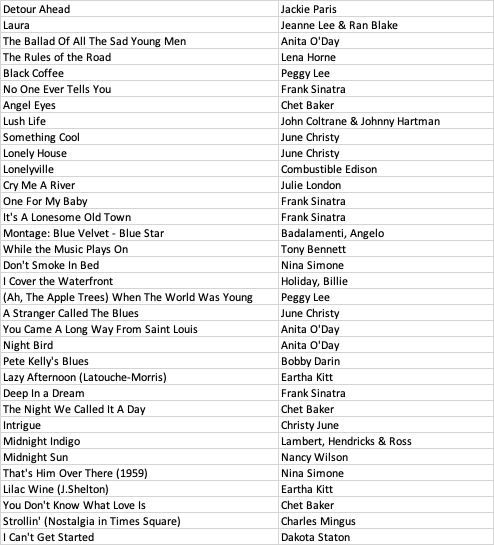
-
Among singers, Tony was really the last living link to the Great American Songbook era, wasn't he? Johnny Mathis and Jack Jones are still with us, and much as I love both of them for different reasons, neither is in quite the same class as Tony Bennett, for me, at least.
-
Yeah, you wonder who is consulted for these kinds of things. I can see a few things being pulled at Tony's request, but the rest?
-
I am now a veteran.
-
A Tony Bennett completist published a list of missing material from that box set. Even lots of stray Columbia-era tracks are missing. We saw him live maybe 15 years ago, and he did the same. That was kind of schtick for him, but it was also very effective.
-
Mosaic Select - Johnny Richards?
Teasing the Korean replied to P.D.'s topic in Mosaic and other box sets...
Thanks! -
-
I dunno, I love many of those Columbia recordings from the 1950s and 60s. Many of the singles were schlock, and he sometimes included schlock on his albums. But some of those albums are very solid for me. I missed hearing the Columbia reverb on his voice during the post-comeback period.
-
Mosaic Select - Johnny Richards?
Teasing the Korean replied to P.D.'s topic in Mosaic and other box sets...
Does the Mosaic booklet give the full personnel on Rites of Diablo? Discogs lists the following: Alto Saxophone – Gene Quill Chorus – Dave Lambert Singers French Horn – Al Antonucci, Julius Watkins Piccolo Flute – Bill Slapin Tenor Saxophone – Seldon Powell Trombone – Frank Rehak, Jim Dahl, Jimmy Cleveland Trumpet – Burt Collins, Ray Copeland Tuba – Jay McAllister -
Given his long career, resurgence in popularity, singular devotion to the Great American Songbook, and preference for jazz backings, I have often wondered whether Tony Bennett may have been a gateway into jazz for some listeners, especially younger listeners. I would certainly think so.