_forumlogo.png.a607ef20a6e0c299ab2aa6443aa1f32e.png)

HutchFan
-
Posts
20,922 -
Joined
-
Last visited
Content Type
Profiles
Forums
Events
Blogs
Everything posted by HutchFan
-
-
 Weekly Recap - PLAYING FAVORITES: Reflections on Jazz in the 1970s Bud Shank, Bill Mays, Alan Broadbent – Crystal Comments (Concord, 1980) Fred Anderson – The Missing Link (Nessa, 1984) Dave Burrell – Windward Passages (hat Hut, 1980) Max Roach Quartet – Pictures in a Frame (Soul Note, 1979) Don Cherry, Dewey Redman, Charlie Haden, Ed Blackwell – Old and New Dreams (ECM, 1979) Jack Walrath – Demons in Pursuit (Gatemouth, 1979) Claude Williamson Trio – La Fiesta (Interplay/Discovery, 1979) Another solid batch, I think. My Max Roach choice may surprise some of you -- since I chose Pictures in a Frame, the first album with Odean Pope, rather than one of the records featuring Billy Harper. I love those records with Billy Harper. I just like Pictures in a Frame more. There's more variety composition-wise -- plus, there's a different balance in the quartet that appeals to me. I think Chattahoochee Red (Columbia, 1980), Max's next quartet record after Pictures in a Frame, is brilliant too. Neither of these records deserve their relative obscurity. I think they're the two best MRQ albums with Pope.
 -
Jack Walrath - Demons in Pursuit (Gatemouth, 1979)
-
sidewinder -- I've never heard this one before. I'm giving it a listen now via YT. Sounds really good! Thanks for the heads-up.
-
-
-
-
-
Marc Johnson's Right Brain Patrol - Magic Labyrinth (JMT, 1995) with Marc Johnson (b); Wolfgang Muthspiel (g, g synth); Arto Tunçboyaciyan (perc, vo)
-
Michael White - The Land of Spirit and Light (Impulse, 1973) I didn't include this record in my 70s jazz survey. It didn't make much of an impact on me when I first got it a few years ago. But a lightbulb went on recently. Now, I wish I would've included it. Oh well. Maybe there'll be a spot for it in the 2nd edition.
-
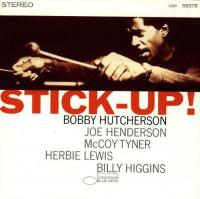
Great photo! Here's another version of Cowell's "Effi": Cowell made huge contributions to a series of outstanding Bobby Hutcherson records: Patterns, Spiral, Medina, and Now. Some amazing music.
-
and
-
Well, this board only exists because we all enjoy making distinctions between more and less interesting forms of jazz, comparing notes. That's what we're doing here, right? Talking about things that interest us. What else is there?
-
Jim, you mistook my intent. I didn't mean that there are no "rights" and "wrongs" in the absolute sense. I am a relativist when it comes to this sort of thing, but not absolute relativist. I can simultaneously recognize some artists are more important than others -- in the historical, musicological, cultural sense -- while also recognizing that a whole different set of artists may be more important to me. The figuring out who's important to me is what interests me. There's no inherent contradiction there. Plus, there's no "leveling of the playing field" or the "there are no rules"-type nonsense that you think I was espousing. I'm not. Another way of thinking about what I said above: I'm approaching this from the perspective of a listener. That is, there is no "You SHOULD like this better than that" or "You should NOT like this better than that." ... You know that it would be absurd for me to say, "You should like Tolstoy more than Dickens." Or "Beethoven is better than Bach." Or "Shakespeare is greater than Chaucer." It's even silly for me to say, "You should like jazz more than classical." Or "You should like jazz more than pop" -- even if I believe that jazz is more interesting than pop (and I do). That's what I'm talking about here. Discovery in the real world, not in some abstract sense. ... And the freedom for an individual to follow his/her nose to the things that address their needs and desires.
-
Peter, I agree with you. At the end of the day, there is no right or wrong when it comes to music. Subjective experience is right at the very heart of it. I had a literature professor in college who greatly influenced my thinking on this sort of thing. He said, "To be an educated person, you need to spend a lot of time in the library. Not because you need to know everything. Instead, the purpose is to discover the authors that speak to you, the ones that address your needs and your concerns. But, if you don't put in the time, you may never discover them." I feel the same way about music. We owe it to ourselves to explore -- otherwise, we might be denying ourselves something meaningful and wonderful -- but, at the end of the day, our greatest obligation is to ourselves. I suppose it's just like what Thelonious said (in so many words), "The artist who is most successful is the one who is most truly himself."
-
Full agreement with you, gents!
-
I'm 52.
-
A few more to add to the mix... David Liebman - Dedications (CMP, 1980) Also, has anyone mentioned the two Stanley Turrentine / Claus Ogerman collaborations? Nightwings (Fantasy, 1977) and West Side Highway (1978) Good one! I picked up that LP earlier this year.
-
Terrible news. R.I.P. I'm grateful so much wonderful music.
-
Duke Ellington - Hot Summer Dance (Red Baron) This version of "Paris Blues" kills me. Extraordinary piano from Duke. No one else can play with such luminous nonchalance. Nobody.
-
Earl Hines - Hines Does Hoagy (Audiophile, 1971)
-
Sonny Rollins - Way Out West (Contemporary/OJC) and The Great Jazz Piano of Phineas Newborn, Jr. (Contemporary/OJC)
-
Roy Eldridge & Dizzy Gillespie - Roy and Diz (Verve)
-
-
Louis Armstrong book review
HutchFan replied to BillF's topic in Jazz In Print - Periodicals, Books, Newspapers, etc...
Sure, it needs to be examined and understood in historical perspective. OTOH, it would be strange to read a new book about Bob Dylan that characterized his transition from a protest-song singing folkie to a rock 'n roller as a "sellout." The author would be bringing an out-of-date perspective to the table. Yes, Dylan's "sellout" was a controversial and important moment -- and it's important to understand that history. But, given the scope of Dylan's entire career, it's no longer the central story of his life. I would make an argument that the same is true of Armstrong. Those old ways of understanding are important to understand. But they're not the story anymore. Plus, when one considers the element of race in Armstrong's story (that isn't there with Dylan), things get even more complicated. The "sellout" narrative becomes reductive, too much of an over-simplification.