_forumlogo.png.a607ef20a6e0c299ab2aa6443aa1f32e.png)

jeffcrom
-
Posts
11,694 -
Joined
-
Last visited
Content Type
Profiles
Forums
Events
Blogs
Everything posted by jeffcrom
-
Today I spun Dizzy Gillespie's complete January 9, 1945 session: Salted Peanuts/Be-Bop (Manor) I Can't Get Started/Good Bait (Columbia) Columbia purchased just two of the titles from Manor, and issued them in 1948 (in their "race" series). The Manor sounds thin and metallic, with lots of surface hiss. The Columbia is warm and rich.
-
It's getting toward the end of the month, and I haven't weighed in yet, so here goes. As usual, I haven't read anything in this thread yet. 1. Hmmm…. Nothing wrong with it, but it leaves me a little cold. Sounds like the latter-day Jazz Messengers, except that the drumming is awfully restrained for Blakey. Everybody is good, but for me, there’s just no “there” there. I imagine most listeners here would disagree. 2. Intriguing music. I would have liked to hear them swing hard for a bit at some point, then go back into the pointillistic stuff, but this was interesting and well done. 3. The “instrument” I recognized first was the Paramount recording studio, which turned out some of the crappiest-sounding recordings of the time. But no matter – this is brilliant, one of the great recordings of jazz. It’s “Play That Thing,” by Ollie Powers’ Harmony Syncopators, with Tommy Ladnier and Jimmie Noone setting fire to everything in sight that day in 1923. I was struck with how much Noone’s second chorus sounded like early Sidney Bechet – or rather, vice versa. Jimmie Noone made some great recordings later, but this is the hottest thing he ever did. 4. Bass, drums, tenor sax, piano, and kora, I think. I like the blend of colors here. No idea who anyone is, but I like this. The kora player is outstanding. 5. I couldn’t help comparing this to track one, since they both seem to be latter-day hard bop, broadly speaking. This is vital and alive, whereas track one seemed kind of artificial to me. Everybody was playing; it swung and it was interesting. I liked this a lot. 6. I imagine that this has been identified by now – it’s from one of the first jazz albums – a collection of Kansas City jazz put out by Decca, first on 78. The track is “Moten Swing” by Eddie Durham’s little band, with Durham on guitar and featuring the great Buster Smith on alto, recorded in 1940. You can hear why Smith was such an influence on Charlie Parker – he’s technical assured, fluid, imaginative, and very personal. Great stuff. 7. A very interesting reconstruction of “Somewhere” by Vijay Iyer, from the 2009 Historicity album. I think this is an imaginative and fascinating way to approach a standard like this – very original and contemporary-sounding. Stephan Crump is on bass, Marcus Gilmore on drums. 8. The lands on or around the northeastern Mediterranean – Turkey, Greece, Bulgaria, Romania – have such incredible clarinet traditions. I can’t get enough of clarinet playing from this part of the world. I don’t know this track, but it sounds like Ivo Papasov on clarinet and Yuri Yunakov on alto sax. Both of them make me want to put my horns in the closet. This is stunning music. 9. Fantasia on “Equinox,” by a couple of excellent and imaginative players. Enjoyed it; don’t know who it might be. 10. Loves me some plunger trombone. Striking ensemble voicings. Hot music! I want to find out more about this track. 11. Nice enough, with the unusual instrumentation, but it doesn’t kill me. It starts to build up a head of steam toward the end, though. I like the clarinetist. 12. My first thought was a Jimmy Giuffre group, but I quickly eliminated that. Melodically, the clarinetist sounds like a restrained Tony Scott, but I obviously don’t know who anyone is. Again, it’s good, but nothing I’m exciting about hearing again. Track 10, on the other hand…. Nice BFT - I love the range of music, and although you can tell I wasn't crazy about a couple of tracks, there was nothing I actually disliked. Thanks for a good one.
-
I gave you the next open slot, which is January.
-
Duke Ellington - The Symphonic Ellington (Reprise mono promo)
-
Today's prime find was something a little different. I stopped by an antique/junk store in Atlanta to see if they had any "new" 78s. There was a big box - mostly 40's pop, but with a few more interesting items. I walked out with half a dozen (for a buck each) - acoustic classical, international and this: Carl Perkins - Blue Suede Shoes/Honey Don't (Sun) I don't have many early rock and roll or rockabilly 78s, and this is my first Sun label. A nice find from a collecting standpoint (worth probably $25-30 in this condition), and pretty cool music.
-
Gerald Wilson - Everywhere (PJ mono promo)
-
Could be. Composer Earle Brown produced "new music" recordings for both labels.
-
Being fascinated by all things concerning William Russell, I've had this CD for years. I've also got an old Mainstream classical LP with earlier recordings of some of the same pieces, along with compositions by Cage, Cowell, and Lou Harrison. Young Warren Smith is one of the performers. I like Russell's compositions - they're engaging and unpretentious. He gave up composing as he got more into jazz, saying that jazz musicians could come up with better music on the spot that he could ever compose. Late in his life, Russell was also the violinist in the New Orleans Ragtime Orchestra, an excellent ensemble which recorded for several labels.
-
Nice! Congrats on the Gennett score. "My Man Jumped Salty...."
-
Doc Evans/Knocky Parker/Jax Lucas - Classic Jazz at Carleton (Soma). An excellent recital, recorded at my wife's alma mater, 30 years before she graduated from Carleton College in Northfield, Minnesota.
-
Which Jazz box set are you grooving to right now?
jeffcrom replied to Cliff Englewood's topic in Mosaic and other box sets...
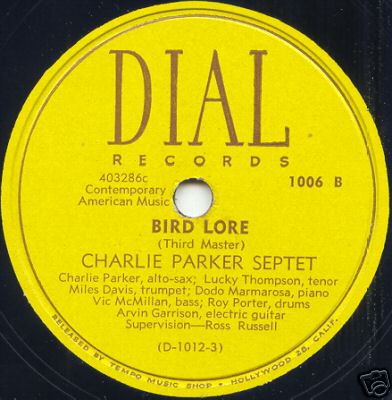
Ornette Coleman - Beauty is a Rare Thing (Rhino/Atlantic); The Shape of Jazz to Come, programmed from disc one, plus the extra tunes from the same session. I bought this set the day it was released. I wrote a saxophone quartet arrangement of "Peace" today. It might suck; I'll find out at rehearsal Friday, I guess. Charlie Parker - The Complete Dial Recordings (Stash); the session with J.J. Johnson on disc four. The master take of "Crazeology" is one of my half-dozen favorite Bird recordings. -
What's your problem, dude? That's certainly never happened to me.... I think about this often; isn't it an amazing thing?
-
Larry, I've often thought that Bird's famous quote was rather poorly worded and not really an accurate description of what he was doing, but I disagree with you about Bird's playing being more free and less systematic harmonically. (I don't know what source you're thinking of - I'm basing this on listening and looking at transcribed solos.) He was very free melodically, of course, but what he played was very harmonically "systematic." That's not to say that his playing was formulaic or predictable, but that it can be easily analyzed/explained in terms of chordal harmony. Bird's quote seems to imply that he was using a lot of elevenths and thirteenths, but that's not really what was going on. (Well, a lot of thirteenths, maybe - but melodically, a thirteenth is the same as a sixth.) Bird's chord extensions tended toward altering the ninths and fifths in dominant chords and implying passing chords which his accompanists weren't necessarily playing. But harmonically speaking, Bird is pretty easy to analyze, once you've mastered the harmonic language Bird's innovations are often boiled down to harmony, but that's only part of it. His rhythmic innovations were even more original - he tossed accents around in a way that nobody has been able to match in the ensuing 57 years. And his "macro-syncopation" - his unpredictable variety of phrase lengths - was maybe the most original aspect of his music.
-
Raymond Burke - A Self Portrait (Land o' Jazz). An obscure 1975 album by the New Orleans clarinetist - I couldn't find a picture online. Burke plays mostly clarinet, but also bass clarinet, tenor sax, tin whistle, and harmonica. Nice stuff.
-
I bought a cheap LP about a month ago - an album of traditional New Orleans jazz on the Crescent Jazz label, pressed on cool red vinyl. The band was Barry Martyn's Legends of Jazz, a slightly hyperbolic name, and the music was recorded in 1973. Well, bassist Ed Garland was kind of a legend, and Louis Nelson is one of my favorite New Orleans trombonists. Besides these two guys and Martyn on drums, the band included Andrew Blakeney on trumpet, Joe Darensbourg on clarinet, and Alton Purnell on piano. I figured that the music was probably good, but not incredible, and didn't listen to the record until a couple of days ago. I was right - it's very enjoyable, but not spectacular. But as I listened, I found six snapshots stuck inside the jacket, apparently taken at the concert during which the original owner bought the album, probably in 1974. The pictures were kind of washed out, but I scanned them, tweaked the color and contrast, and did some cropping. They're still not great, but I thought they were worth sharing, since all of these guys except for Barry Martyn are now gone. Thanks to some anonymous music lover in 1974.
-
Mine is Creole 1, but it has the same titles as your copy of Creole 3. I just took a look at the Lord discography, and Creole 2 is listed, with a recording date of 1948 or '49 (I've already forgotten which). Creole 3 is not listed, but like I said, it appears to be the same as Creole 1. Independent labels move in mysterious ways their wonders to perform.
-
Jeremy Steig - Temple of Birth (Columbia). Trippy 70's fusion. [insert wry Chuck Nessa comment/emoticon here.]
-
I played all my Wilbur Sweatman records today. Sweatman' Original Jazz Band recorded 24 sides for Columbia between 1918 and 1920. I've got 13 of them, from his earliest Columbia to his last one: Regretful Blues/Everybody's Crazy 'Bout the Doggone Blues But I'm Happy Dallas Blues/Has Anybody Seen My Corrine? Ringtail Blues/Bluin' the Blues A Good Man is Hard to Find/That's Got 'Em Lucille/I'll Say She Does Kansas City Blues (other side is by the Louisiana Five) But/Think of Me Little Daddy and: Ringtail Blues (one sided Little Wonder) I'll do a post about Little Wonder records soon - that's a pretty interesting story. Sweatman's music is a lot of fun, and was probably a blast to dance to back in the day.
-
Sorry to hear about your situation.
-
Willis Jackson with Von Freeman - Lockin' Horns (Muse). When I was at the Jazz Record Mart in Chicago last week, they put this on the sound system right after Warne Marsh's All Music on Nessa. I bought it right off the turntable.
-
Arthur Blythe - Elaborations (Columbia)
-
Two interesting new acquisitions: Clarence Williams - Chocolate Avenue/Dispossessin' Me (Vocalion, 1933). "Chocolate Avenue" is supposedly Sun Ra's earliest recorded composition. According to the Szwed biography, young Mr. Blount sent several tunes to Williams' publishing house for consideration. He never heard back, but then this tune appeared on record. It's interesting that the other side is credited to Schiller, Bishop and Williams, while there is no composer credit given for "Chocolate Avenue." It's a nice little medium-slow tune, played by trumpet (Ed Allen), clarinet (Cecil Scott), Williams on piano, and washboard. There's nothing particularly original about it except for one or two slightly unexpected chord changes. Ray Burke's New Orleans Blue Four - Slow Blues/Dandy Inn Five - Mardi Gras Blues (Creole, 1943/39). This record is listed in the Lord discography, and the Dandy Inn Five side is in Rust (the other is after his 1942 limit), but this record is otherwise a mystery to me. Several early Burke acetates were issued on American Music, but not these. This Creole label doesn't seem to be related to a later reissue label of the same name. The labels are very plain, and the catalog number is Creole 1. Musically, it's very good; Burke is already recognizably himself on both sides. Anybody know anything about this one? Clunky, I should count my 78s, but I'm a little scared to.
-
Wow - that takes me back. I played that chart back in high school. The retired band teacher in me also noticed that Mr. James used two different fingerings for the trumpet's E (concert D) - the standard first two valves sometimes, and the "incorrect," slightly out-of-tune third valve alone sometimes. It's obvious that he knew just what sound he wanted on each note. Thanks for posting these videos.
-
This interested me, so I pulled out all my Harry James sides with Ziggy Elmer; not much - three 78s and one 45. Alas, no trombone solos on any of it. I'm going to keep my eyes and ears open, though.
-
Tony Parenti - Jazz Goes Underground (Jazzology). Parenti and Knocky Parker join the cream of the Atlanta Dixieland scene as of 1969.