_forumlogo.png.a607ef20a6e0c299ab2aa6443aa1f32e.png)


Larry Kart
-
Posts
13,205 -
Joined
-
Last visited
Content Type
Profiles
Forums
Events
Blogs
Everything posted by Larry Kart
-
What Chuck said. Can't forget Dusty putting his little kid Darren on his lap during post-game interviews after a bad loss in an attempt to deflect tough questions (although Darren, now 13, probably is not lap size anymore). Also, when things go really bad, wait for Dusty to cite his racist hate mail. P.S. You may remember little Darren almost getting run over in the 2002 WS: https://www.youtube.com/watch?v=WzV7x8WcR4g
-

2015 MLB Season - Let's Play Two!
Larry Kart replied to JSngry's topic in Miscellaneous - Non-Political
Only saw the Murphy play in real time and in re-play right afterwards, but my impression was 1) that he was screened to some extent by the runner, who was very close to the charging-in Murphy, and there's no defense against that, and 2) that he was expecting the next bounce of the ball to be in line with its previous bounces and placed his glove accordingly as he ran in, but instead the next bounce was a fair bit lower/flatter than the previous ones (some irregularity in the field?), and the ball went under his glove. Could a top-notch second baseman have made the play? Probably. Should Murphy be excoriated because he didn't? I don't think so, any more than Eric Hosmer should have been for the play he failed to make the night before. Tough chances, both of them -- nothing in the Bill Buckner or Leon Durham class. -
Jim -- I'm not sure what, in terms of actual musical results, you mean by "corporation" versus, a la Glenn Miller, " they played more like highly skilled employees." Name another band that sound "corporate" and maybe I might understand.
-
http://www.amazon.com/50th-Anniversary-Paul-Whiteman/dp/B004UFK2M2/ref=sr_1_1?ie=UTF8&qid=1446156460&sr=8-1&keywords=paul+whiteman+50th+anniversary Some fabulous Teagarden, a supposedly original version "Rhapsody in Blue" (I say supposedly because I don't know for sure what the musicological-historical issues are there) with Buddy Weed on piano that sounds great, not like the concert piece it's become but a mid-'20s "jazz" piece, everything played by a remarkable group of zestful vintage studio guys, including Al Gallardo for the clarinet gliss on "Rhapsody," all recorded with excellent presence by the Enoch Light crew.
-
Do you remember, have a poster for, a concert at the Unitarian Church in Evanston, with Roscoe, Joseph, Malachi, and (I think) Philip? That was sublime. Also, the Abraham Lincoln Day concert in Hyde Park (I think), where Roscoe and Lester wore tail coats and stove pipe hats and began with what seemed like an at once affectionate and semi-satirical takeoff on the Baker-Mulligan Quartet?
-
Sorry, Ted -- They play for me.
-
http://www.amazon.com/Post-War-Era-Tommy-Dorsey-Orchestra/dp/B001DOOMLA/ref=sr_1_39?s=music&ie=UTF8&qid=1446074044&sr=1-39&keywords=tommy+dorsey What a handsome and distinctive band this was, with subtle charts (mostly from Bill Finegan) and striking soloists -- lots of Charlie Shavers, tenormen Don Lodice and Boomie Richman, Dorsey himself, and some brilliant early Buddy DeFranco. Good liner notes from Loren Schoenberg. Some samples:
-
Henry Brant's Concord Symphony, his recasting for orchestra of Ives' Concord Sonata. Had time to listen to just the first five minutes or so -- very impressive. Got the Dennis Russell Davies recording, not the Michael Tilson Thomas.
-
Miles Davis Complete Blackhawk
Larry Kart replied to LouisvillePrez's topic in Mosaic and other box sets...
Strange that Mobley was making great albums under his own name for Blue Note at this time. I'll certainly listen to the Blackhawk set with some pleasure, but I agree with mjzee that it doesn't really jell. Miles reportedly was ragging on Mobley for musical and/or personal reasons, and I don't think that Hank's laidback, light-on-accents rhythmic feel jibed with Jimmy Cobb's glassy evenness, fine as that was for Kelly and others. Hank needed more interaction from his drummers. -
Jsngry was asking about bassist Arthur Phipps, not pianist Nat Phipps. https://en.wikipedia.org/wiki/Art_Phipps
-
JSngry wrote: "I never (consciously) knew pre-free jazz (or for that matter, pre-rock music, of any kind) or the world(s) around it as present-day realities." You're right, what a divide that is. To hear Coltrane's sheets-of-sound come along out of semi-nowhere (or so it almost seemed), and then to hear it evolve into "Chasin' the Trane," and to encounter Ornette and, if you were lucky, "get" him/it! As I once put it, "History is always happening, and it's happening to us." Very easy in the '50s to think that was not the case.
-
Martin in his time, up to and including all the time he spent in Ornette's corner, was pretty darn important. Not the first serious (or "serious") jazz critic -- Martin was both -- but by bringing his style and attitudes to writing about jazz (he also was very good about TV shows, comic strips, and other forms of so-called popular art) he cleared away a lot of fan-boy sentiment, or at least made it harder for those who purveyed it to do so. The Ornette connection is important not only because Martin put all his chips down there when very few "established" guys did, but also because it placed him squarely in the flux of jazz's rapidly evolving present from the '60s on, which is not a place where he was temperamentally comfortable by and large, avant-garde/revolutionary trappings of most any sort being anathema to him. Thus the range of things that appealed to his taste became increasingly narrow, and barring Ornette's intermittent reappearances, there was little he could be genuinely enthusiastic about. When he did blow his horn about something newish in later days -- the World Saxophone Quartet? -- I usually went "oh?" On a personal level he could be quirky, and I think I told my two favorite Martin stories here before. The second and better one took place at a Duke Ellington conference at the U. of Illinois at Chicago in the early '80s. Gunther Schuller was speaking, and Martin and I were sitting next to each other in the auditorium. Smoking was forbidden, and at the time I was a smoker. Getting antsy after about 45 minutes, I pulled out a pack of Dentyne and put a piece in my mouth. Martin looked over with an expression of bemused contempt on his face and said, "You chew gum?" Pretty much aware of the tone of this remark, I also was so startled by it that unintentionally I came up with what may have been the perfect retort -- "Sure, you want some?" (When and where Martin grew up -- in a neo-patrician setting in Northern Virginia in the late 1930s, IIRC the son of a retired military officer and a socially imperious mother -- gum-chewing was something that only teenage girls behind the counter at the five-and-dime engaged in.)
-
@Paul, again -- No, I don't think I miss writing criticism; what I have to say in that vein here, and the conversations that result, is more than enough action, and action of the right kind. OTOH, fairly often I do get cranky/pissy when I see someone out there in the world at large who is operating in ways that seem fast and loose to me. When I have that kind of response, it often feels unhealthy to me, but maybe if I held my tongue that would feel worse.
-
@Paul -- Without doubt, a jazz critic's dream. Martin was a role model for me there early on, as he was for many of us on the ship of fools, but his feet, as Allen says, were not entirely clay-free (nor are mine, for that matter). OTOH, I try very hard and usually successfully to remain aware of what it is that I don't know and proceed or chose not to proceed accordingly. However, like Martin I'm at times drawn like a moth to technical issues (how could one not be, given their importance?) What I'll do then, if I feel I need to/want to, is run my bright ideas by a technically-versed-to-the-nth-degree longtime professional jazz musician and good friend to see if what I have in mind makes sense to him, or at least does not contain howlers. A no-bull guy, he pulls no punches. Further, I feel that it's in the nature of jazz that there is not at all times a perfect match between terms for what's happening and what actually is happening, nor is there also always a perfect match between terms for what's happening in jazz and terms for what's happening in music in general (and classical music in particular). See, for example, Ornette, Ayler, Cecil Taylor, Monk or, for that matter, Johnny Dodds. I like to think that this might make some of my putzing around/would-be-reframing of stuff useful.
-
Don't know if this is the right forum, but last night I had a dream (it was close to a nightmare) in which Martin Williams (whom I knew fairly well in real life) was insisting that Cannonball Adderley was a key influence on Art Pepper. I knew that Martin's point of view here was batshit -- Art was who he was musically long before Cannonball emerged from Florida in 1955 -- but in the dream I felt at once constrained/unwilling to confront Martin with his error and eager to do so -- constrained because what Martin was insisting was the case was so impossible as to be potentially quite embarrassing to him if I pointed out how wrong he was (and I didn't feel like dealing with the fact of confronting and then embarrassing him), but eager to do so not only because I knew he was wrong but also because his underlying motive in making this goofy claim seemed to me like it might have sprung from an annoyingly smug attitude of reverse racism on Martin's part (as in, surely a figure like Art Pepper couldn't be that good on his own hook). Before that, another nightmare.In this one my late friend Bob Wright (primarily a pianist and a brilliant one, though he also played drums and trombone) was getting ready to play trombone at a local jam session, and he wanted me to accompany him on piano. As he ran over the tunes he wanted to play (one of them was "Crazeology" -- in the dream Bob was a fluent J.J. Johnson disciple, in real life he wanted to play like George Brunis and did), I tried to tell him that I didn't know how to play piano, couldn't even read music, etc., but he insisted that if I acted like I knew something about jazz (which I do), then I had to be able to actually play "Crazeology," etc. We got to the club where the session was to take place, and thing went downhill from there."Crazeology," indeed.
-
2015 MLB Season - Let's Play Two!
Larry Kart replied to JSngry's topic in Miscellaneous - Non-Political
Jim -- You are a naturally funny man. -
What live music are you going to see tonight?
Larry Kart replied to mikeweil's topic in Live Shows & Festivals
Heard that trio in Chicago a few weeks ago. Very fine. Great that they're taking it on the road. -
I caught Minnie Riperton and the Buddy Rich Band at the Electronic Playground in Chicago in 1970. Dan Morgenstern and I were there to talk to Rich.
-
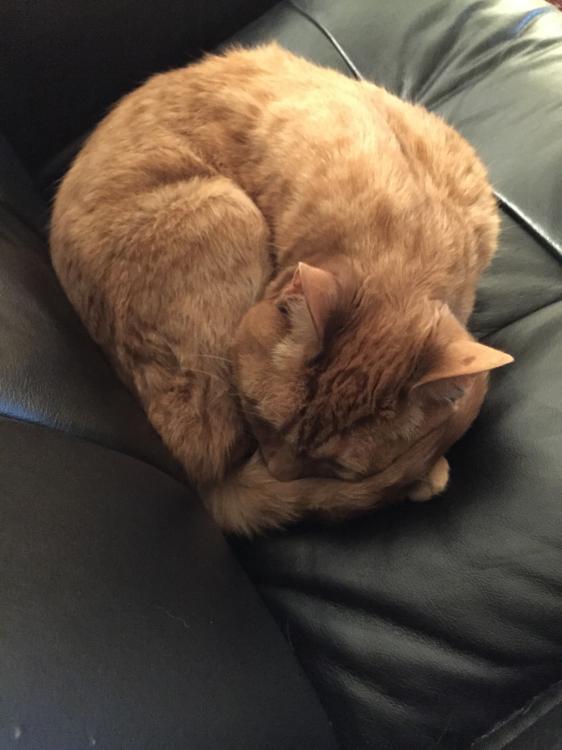
Have a shelter cat, my second, who's now about 10 -- love him, he kind of saved my life or at least nudged me toward sanity at one point -- added a terrific youngish shelter dog a year ago last August at my wife and stepson's urging. Was concerned about how Baby the cat and Scout the dog (see below) would get along, but everything's cool.

-
Bought and then returned Valery Ponomorev's "A Star for You." He's a good player, but he defaults into the upper register way too much -- messes up his lines and makes my head hurt.
-
Maybe 1) or 2)? 1) 2)
-
No, I don't have his ear. We've exchanged e-mails from time to time over the years, some of them friendly, when I had information on a topic he was pursuing, but also on several occasions when I was pissed because I thought he'd done something fast and loose, callow, smug, and kind of self-serving, like the Beehive set review. OTOH, I have friends who have had much more contact with EI than I have had who say that he's a great guy. BTW, in the apology that Jim linked to, I still catch a whiff of schmutz, e.g. "In addition, if the cats at Organissimo are so appalled, I'm really whistling in the wind, as there can't be many people that care about these Bee Hive records who aren't at least lurking on Organissimo." If we "cats" and those who are "lurking" about here are such a small, isolated crew, why did you take the trouble to write up and post your review in the first place? She was definitely portrayed as a reviewer from an earlier generation, but I have no problem believing this happens now. I read the theatre reviews in the Guardian frequently and there is no question that when it is a "big name" starring on a West End show, at least part of the review is about the star system in general and whether this star in particular transcends all the fuss to deliver a decent performance. (In particular all the fuss around Benedict Cumberbatch as Hamlet, in what from several accounts seems to be a pretty poorly thought through production. At one point the play actually opened with the To Be or Not to Be monologue.) Every so often there will be an article bemoaning the star system in general. You never really know what is going on with a critic and the bees in his or her bonnet. I used to read Chris Jones, the Tribune critic regularly, (til his columns went behind a paywall) and if it was a Broadway transfer (or a play on the scale of a Broadway transfer), a chunk of his review always went to discussing if it was a union production or not. Bottom line is that was not the most outlandish part of that film by any means... As far as Beehive goes, I do expect to get the set relatively soon, though I am still working on clearing off some shelf space... On second thought, you're right about that scene lining up fairly well with reality. Maybe I just didn't like the relative bluntness with which it was written and played.
-
2015 MLB Season - Let's Play Two!
Larry Kart replied to JSngry's topic in Miscellaneous - Non-Political
No -- I was paraphrasing what he said and shouldn't have used quotes. -
What struck me was not merely how much paella Davis put away but the measured, savoring things all the while way he did so. IIRC, he picked the restaurant, too, having turned thumbs down on several others as we walked through Greenwich Village. In fact, now that I think of it, in this respect he reminded me of Chicago tenorman Ari Brown, who was a member of the Mike Reed-led band that I accompanied on a European tour in 2008. Slow but steady, savoring as he went. Maybe it's a thing with guys who grew up on the South Side and went to DuSable High.
-
https://en.wikipedia.org/wiki/Trencher_(tableware)