_forumlogo.png.a607ef20a6e0c299ab2aa6443aa1f32e.png)

sgcim
-
Posts
2,793 -
Joined
-
Last visited
Content Type
Profiles
Forums
Events
Blogs
Everything posted by sgcim
-
Just from that Jimmy Dale session David Piltch put up on You Tube, you can hear that the playing and writing was state-of-the-art for its time. Even the audience seems like they're hip! It reminds me of the scene in Great Britain in the 50s. They even gave the great Lenny Breau his own TV show for a short time in Toronto. Thompson had a lot more visibility than Ed, because he toured with John Handy back in the 70s (including the well-known Monterey jazz festival performance), and then toured with George Shearing for a while. Ed barely left Toronto!
-
I've been fooling around with arranging "African Flower" for guitar, and was wondering if Duke wrote any other small group, modern, modal sounding pieces like this.Anyone know of any?
-
Thompson had a lot more visibility than Ed, because he toured with John Handy back in the 70s (including the well-known Monterey jazz festival performance), and then toured with George Shearing for a while. Ed barely left Toronto!
-
Besides Desmond enthusiasts, you don't know how many jazz guitarists are flipping out over this!
-
Beautiful playing by Bickert, the band, and fine arrangement of a tune I've got to check out. Thanks, Ted! The guy that posted it on you tube is a bass player named David Piltch, and he's got some other good stuff from that time period.
-
Do you know if Don has any trio tapes of him playing with Ed that we haven't heard before? I can't wait for the Desmond/Bickert/ Thompson/Fuller and/or Clarke stuff to come out.
-
The guy was a tremendous ballads singer, and he married Claudine Longet, the beautiful, boyfriend shooter! Who knew that The Pawnbroker had a love theme? Who was the guitar player on AW's MacArthur Park? Mandel, Grusin and Elliot; all working on the same show.
-
It says, "video unavailable". I think Peter Erskine was in the band during that time period, and the thought of seeing him and other guys in the band being forced to sing the lyrics of the song while waving their arms in circles is so pathetic, that there must another video of this somewhere. I'm still trying to figure out the symbolism involved in the Andy Williams version, where he comes out for the last verse dressed all in white. It's gotta involve either the theme of resurrection , or maybe even The Second Coming; they thought in grand terms back then... I like the way Andy left the stage when the orchestra took over, and then came out all in white to sing the last part .Must be symbolic or something... Ted's right; the drummer played the schist out of that chart, and I liked the way they let the guitarist rock out on parts of the instrumental section. Jimmy Webb talks about the time that he was writing great tunes like that as a period when emotion was burning out of his brain, and it just seemed to wind up as notes on the staff. Sounds right to me.
-
I like the way Andy left the stage when the orchestra took over, and then came out all in white to sing the last part .Must be symbolic or something... Ted's right; the drummer played the schist out of that chart, and I liked the way they let the guitarist rock out on parts of the instrumental section. Jimmy Webb talks about the time that he was writing great tunes like that as a period when emotion was burning out of his brain, and it just seemed to wind up as notes on the staff. Sounds right to me.
-
Phil Woods!!!!!
-
Alex North - A Streetcar Named Desire
sgcim replied to Teasing the Korean's topic in Recommendations
Very programmatic.Nice piece. -
Album Covers With Everything But The Phone Number
sgcim replied to JSngry's topic in Miscellaneous Music
That's no fair! I spent a lot of money for that dawn LP years ago, and they gave me the one with all the Spanish soldiers on horses on the cover; not the Marilyn Monroe wannabe! -
If you want to get rid of any issues that have articles involving Eddie Costa or Dick Garcia, I'd be interested.
-
Why do so many solo pianists play walking bass in the left hand ?
sgcim replied to Gheorghe's topic in Musician's Forum
I never liked it either. It tends to sound confusing and monotonous, because it's the same timbre paying single note lines and playing single note bass lines At least when they play piano duos, they're both free to add chords that define the harmony more, but when one pianist does it on an acoustic piano, it's the same repetitive pattern of Root, second, third, approach note to the new chord, over and over again. They use it when they're practicing blowing, but without changes, it sounds like an idiot's version of counterpoint. -
Yeah, she brought the maracas to a whole new level. There are Maracas clubs all over the world today, thanks to Gail. Bill said he heard she was last in Seattle; that would account for the proliferation of Jazz Junkie Hospitals and Maracas Clubs reported there. It's a shame you can't really make out her face; she could be either a beautiful woman (she did work as a model and one of those camera girls in clubs in NYC), or she could be a very nerdy-looking woman. Bill said she was normal looking. She let her freak flag fly when she got back with her friends in California, Carol Easton said she would dress up like a man, wear two different types of shoes,- an early version of a hippie freak.
-
Let me know if that worked. see above.
-
He could be pretty obnoxious. He bugged Judee Sill so much once that she took off his belt and ran after him, whipping him with it, with a bunch of people looking on.
-
I right clicked on the image Bill sent me as an e-mail and clicked on 'copy image', and then pasted it here. What should I have done?
-
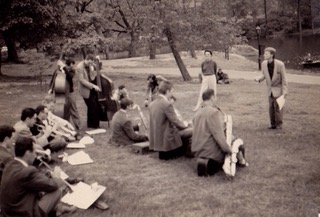
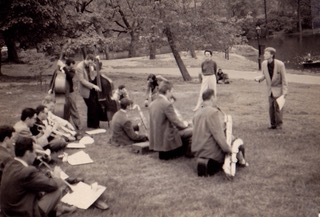
I finally hit pay dirt when Bill Crow sent me this picture today of Gail Madden with Mulligan in NYC, when he couldn't afford to rent out a rehearsal studio, and decided to hold the rehearsal outdoors in Central Park. She's the woman standing closest to Gerry, quietly observing the band, trying to decide at which point in the arrangement her Maracas would be most effective. Bill remembers her as a normal looking woman, but very strong-willed, as she tried to put together the Jazz Junkies Hospital, with Bird as her first client. The picture is very blurry, even when you blow it up:
-
I did some searching on the flute sonata that Handy wrote for Eddie Caine (The Caine Flute Sonata), a well-known winds player in NY for many years (played flute and piccolo on the Sketches of Spain album, and other things Gil Evans did), and it seems that Handy destroyed the Master for both the recording of The Caine Sonata, and an album that he and his wife (Flo Handy, soon to become Al Cohn's wife) made, because the psycho thought his wife sang so well, she would supersede him in his career. Both recordings were done at about the same time, so he apparently 'stole' both, and they were never found. Hey, if you can break your wife's heart, why not break your best friend's, also...
-
I just listened to it. The first two songs(?) of the Suite were pretty bad. Just repetitive dissonant chords in rhythmic unison. No strong melodic invention whatsoever. Just those repeated arp triplets. I can see why the NY Saxophone Quartet refused to record it, if they only played the first two parts. Finally, by the third section of the suite, he woke up. Real melodic invention, nice harmonic movement, and some playfulness with the texture. The rest of the sections were just as fun, with an ostinato that allowed for some improvisation by the players, which were probably the highlight of the piece. Nowhere near the level of the poetic Sauter Quartet that Jim posted, but if you skip the first two sections, definitely worth listening to.
-
Stan Getz Quartet at the Village Gate November 26th, 1961
sgcim replied to soulpope's topic in New Releases
Keane wasn't running Bill's affairs for him then, so it was his choice to record with Russell. He owed Russell a lot for featuring him on All About Rosie, and Concerto for Billy the Kid.I wonder what was going through Evans' mind during the Living Time" album? -
There's not much to add to GOM's exhaustive web research on GH., but I always wondered what happened to GH after 1970. It turns out he wound up playing piano at a few resorts up in the Catskills, including Grossinger's and the Granite Hotel, according to the dissertation mentioned in the OP's post. Most interesting are the three pieces he wrote in his later years, two Saxophone Quartets (one recorded by the New York Saxophone Quartet), and the Caine Flute Sonata. Has anyone heard any of these pieces? How are they? Are they available on disc? Handy felt his writing career was destroyed by his eighteen year addiction to heroin. He remained on methadone up to his death.
-
Stan Getz Quartet at the Village Gate November 26th, 1961
sgcim replied to soulpope's topic in New Releases
Helen Keane pretty much took care of every aspect of Bill Evan's life once she became his manager. Before that, it seemed to be a regular sight in NYC of Bill Evans sitting on the sidewalk next to all his earthly possessions, because he had been evicted again. I don't know if HK was in charge of his affairs during the 'Space Age' album; I'll ask that pianist friend of mine, who knows most aspects of Bill's life. His sister calls him a Bill Evans idiot savant! Evans was no stranger to contemporary music such as JITSA; he astonished Gunther Schuller by sight reading Milton Babbitt's "All Set" including dynamics and articulations at the same college concert that "All About Rosie" was premiered. The other players needed hours of rehearsal and practice before the concert to get the piece down, and these were legendary East Coast studio/jazz players like McKusick, etc... -
Stan Getz Quartet at the Village Gate November 26th, 1961
sgcim replied to soulpope's topic in New Releases
There was a type of unapproachable 'no man's land' that was involved with trying to play with Evans on his own home turf. If Helen Keane wanted him to make an album with such diverse players as Herbie Mann, Jeremy Steig, Warne Marsh, Kenny Burrell,, Geo. Russell, Paul Bley, etc..., he'd loosen up enough to follow where they were going, and make a record that would satisfy her and the record company. But once it got to his domain, his trio, even players on the level of Gary Burton had a hard time fitting in. In Burton's autobiography, he talks about two or three times where he tried to sit in with the Evans Trio at large festival concerts. They didn't give an inch, and Burton himself said that each time he played with Evans, it was a dismal experience. The same thing happened with the great guitarist, Lenny Breau, who like Burton, had modeled his approach to harmony on Evans' records. When LB sat in with the Evans trio in Toronto, the results were disastrous, according to friends of his who were at the club that night. Even when Marc Johnson was first playing with the Evans trio at the VV, I went to the bathroom during the break, and Marc Johnson and Joe LaBarbera were having an intense conversation about playing with Bill on ballads. Johnson was complaining to LaBarbera, "But I don't understand what he wants me to do!" LaBarbera answered, "He wants you to get that 'floating' feeling on ballads." Strait is the gate that leads to Bill Evans, my friends! I've posted a recording of myself playing a duo here with one of Evans' most intense disciples on the tune, "My Foolish Heart". I couldn't even begin to tell you what an extraordinary experience that was, because the guy wasn't giving an inch when we were playing without a rhythm section. It felt like an entire orchestra was playing tons of different lines and harmonies when I was playing both the melody and my solo. I'll never forget it. Strait is the gate!