Jump to content

AllenLowe

Former Member
  • Posts

    15,487
  • Joined

  • Last visited

  • Days Won

    4

Everything posted by AllenLowe

  1. I've been trying to warn you guys about Yanow -
  2. well, I don't know about the Detroit pianist, but I'd be happy to read a collection of Chris Albertson notes - to get back to the subject at hand, I actually DO NOT like Hentoff and his liner notes, which always strike me as lazy and hastily done - I don't really know how Hentoff got such an inflated reputation (and honors from the NEA) - as a music writer he is knowledgeable but never in depth, IMHO - also, talk to a few musicians of the 1950s and 1960s generation who ALWAYS told me they regarded Hentoff as a guy who would never be involved in a project unless it was somehow self-aggrandizing - he was NOT liked or respected by most of the older, post-WWII jazz guys that I knew -
  3. the director, Michael Roemer, was at Yale when I was there in the late 1970s - interesting guy - he also directed a movie that came out in 1969 called The Plot Against Harry, about a Jewish gangster - worth seeking out -
  4. I'm going to wait for the Quadrophonic mix -
  5. 1) well, it may not be nice, but if Mack says it I would believe it - he's an interesting and quirky guy and one of the most knowledgeable American music historian/researchers. He has earned his cynicism. as an aside, he once told me he had an acetate somewhere in his house of early Peck Kelley - but I have not heard from him since - too bad - 2) there are actually 4 Benny Greens - the fourth is a shoe salesman in Miami -
  6. on the Tad Dameron LP Barry made he had Gene Taylor on bass, and it sounds like they recorded Taylor direct to the board - he sounds very buzzy, and Taylor also has a tendency to play wrong notes - unfortunately almost all of the subtlty of Barry's touch is lost - I have one Barry Harris/Bill Evans story. Around 1979 or so Barry came up to New Haven to do a concert for me in a recital room at a local music school - I told Evans's wife about it - after the concert I was walking down the stairs with Barry and who did we see rushing up the stairs - but Bill Evans! He was late, but they greeted each other warmly (Barry told me he used to run into Evans practicing at the Riverside Studios) - and had a nice talk, as a matter of fact, Barry told me later that that was the last time he saw Evans -
  7. I actually doubt than any of the remastering of the Riversides or Prestiges have used any noise reduction/hiss reduction, as they were working from open-reel masters that were very good to begin with and relatively quiet - the only time I have ever heard this done was with the Collectables Atlantics, which are really F'd up - as for transfers to digital, I have done a ton of LP to CD work using good converters to 16 bit CD/CDR, and the copies are indistinguishable from the orginals - one of the keys is not to process but to transfer, and not to go through more than one conversion stage (though I have used CEDAR on occasion with good results) - even direct to DAT sounds great if the machine is good and has decent built-in converters (like the Panasonic 3800 DAT)
  8. you guys laugh now - but it ain't easy to impregnate a movie star -
  9. my mistake - that was Berigan -
  10. that's a good fest - but it was really Dan Gould's idea, the whole thing, they stole everything from him - he's just too modest to admit it - also, Bresnahan was the original director, but they found him too abrasive and had to can him -
  11. Gilman always used to talk about how old art (talking everything from theater to literature) was tied to old gestures - and that art's purpose was not give people the same old answers but to ask new questions -
  12. "Brad Mehldau -- stick to playing the piano mate" - actually I'm not sure that even that is a good idea - I just heard him on BET Jazz playing the biggest pile of semi-new age piano garbage I have ever heard -
  13. hey Fasstrack - I will have to disagree on this one - Barry did tell me on one occasion (back in the 1970s) that he did not like recording, and I did hear him so much on the 1970s/80s as to be frustrated by his recordings (though two of the Riversides come closest - the Jazz Workshop and the trio with Elvin Jones - also, a nice later "live" date at Maybeck) - I think, also, he is difficult to record and this is reflected on some of the 1970s records - his touch is so subtle that on some of those mixes he gets a little buried in the rhythm section - when I heard him at Jimmy's (must have been the early 1970s) he was in a duo with Wilbur Little - no one was listening, and it was like hearing him play for his own edification, almost like practicing at hime - and was the best I ever heard him sound -
  14. glad that you mentioned Green - he would REALLY be my nominee for worst notes - pseudo-erudite, elliptical in the worst possible way, generally FOS -
  15. and if his kid records one more version of "Tomorrow" I may have to kill someone -
  16. though I do get a little tired of the naked pictures of his wife on every cover -
  17. "I was going to mention a set of notes that offended me, but then I realized they were written by someone who's registered on this board, so I'll hold my tongue. (Not Kart, Albertson, Lowe or Sangrey.) Have great respect for this person as a musician; he just oughta get somebody else to write the notes." now wait...I though Jim's notes on that last Organissimo CD were pretty darn good - especially the reference to 96 Tears -
  18. thanks Larry - I don't know if you've ever read Richard Gilman, a theater critic (and a former prof of mine, who is now, sadly, dying) - but he makes much the same point, I think - arguing against critics who are always trying to put art in a convenient social context (think also Sontag, "against interpretation ") - this is important stuff - as Gilman says, art really offers an alternative history, ""a counter-history, the generation of a psychological and aesthetic alternative to the prevailing artistic and social order". There is also what Beckett has said in describing an artist, "he has nothing to say, only a way of saying it." Beckett's book on Proust is quite brilliant in this regard, and many of the same points are made by the French novelist Robbe Grillet in "Toward a New Novel." Coming to grips with this kind of thind changed my life, my whole approach to composition and performance - Gilman used to have a little saying when someone questioned the so-called "reality" of a character in a play (like, for example, Didi and Gogo) - someone would say, who are these people? They don't really exist anywhere, they are unrealistic. Gilman would say, "they exist on the stage." You can really make a parallel between this and people who attack new music as being outside of accepted creative/artistic contexts; this is how they went after Ornette in the early days, and Ayler, and a thousand others (and still do so - see Marsalis/Crouch, two heads on one critical body) -
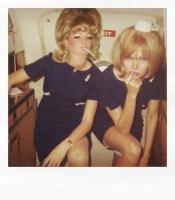
  19. well, ok, I didn't wanna do this, but if you guys insist - I'm the one on the right -
  20. on the other hand - his clarity and depth, playing solo at that birthday party, tells us something else important - because it is also true that the best playing I have ever heard from Barry Harris was when no one was listening - at the bar Jimmy's in the 1970s, and one day after one of his classes when he was basically practicing and talking to me over his shoulder - so we need to worry a little bit about what that recording light (and the presence of an audience) does to a jazz musicain - I know from experience that when the tape is rolling the brain seizes up in odd ways -
  21. a lot of Evans's issues resolve around his addictions - and the question might be, did the addiction cause his self-centeredness, or did his self-centeredness cause his addicition - this is something people have been arguing about for years with alcoholism, about cause and effect, and I don't know the answer. At the end he was definitely committing a slow suicide, shooting coke and retreating deeply into himself, complaining regularly about lack of recognition - strange, since he was in incredible demand at the time. The other thing we need to think about is the depression that ran in his family; like a lot of people in that era he was probably medicating himself -
  22. I'm a little tired of that song - however, Al Haig used to do a 3/4 version of it (in the late 1970s) that was quite nice -
  23. Evans is a complo\icated subject, and Larry kart's essay deserves to be read because he certainly captures the ambivalence I've long felt about Evans's playing - I got to know Evans's wife pretty well in the late 1970s and early 1980s and met Evans on occassion - if you'll forgive the amateur psyhologizing, he was a brilliant guy who suffered fits of what seemed to be a kind of narcissistic depression. He was completely self-directed on some occasions, talkative and fascinating on others, and I do wonder if the strange variability of his playing reflects this. On his 50th birthday his wife gave a party and Evans sat down and played, unprompted, Stars Fell on Alabama, and it was absolutely perfect, unselfconcious and relaxed and without artifice (it probably helped that his audience included George Russell land Warne Marsh). Would that he could have translated that directness to all of this recordings -
  24. last episode: Tony is shot dead by Carmella after she catches him in bed with the real estate agent; Anthony Junior takes over the gang after a power struggle in which he kills Syl, Paulie, and Imperioli in hand-to-hand-combat; Anthony Junior than goes to bed with Carmella in a Greek-Oedipul finale; Vito isn't really dead, but living in Provincetown in the Witness Protection Program with Jim Nabors (who used to have a piece of the Rock); Bobby gets shot at the Jones Beach toll booth; the shrink marries Uncle Junior. Sorry to ruin it, but I got a look at the script -
  25. he got shot at at least once - while driving -
×
×
  • Create New...