Jump to content

EKE BBB

Members
  • Posts

    12,234
  • Joined

  • Last visited

Everything posted by EKE BBB

  1. Who are you and who is Andrew Hill?
  2. Hey, brownie beat me to it! This is a great album, IMHO, recorded with only-Japanese musicians. Though AMG only gives it 21/2 stars.
  3. EKE BBB

    Stan Getz

    Every time is a good time to start with Stan Getz, sal. He´s been underrated by many jazz critics (and jazz morons) just because some of his records (especially with the bossa nova thing) sold rather well. This has been unkind, IMHO, because he is one of the greatest sax players of all times. I´ll throw in some of my favorite recordings: -For early Getz, get The complete Roost recordings -Then you could go into the trilogy (well, at least I call it the trilogy, although it has no sense at all) WEST COAST JAZZ, THE STEAMER and AWARD WINNER. -FOR MUSICIANS ONLY is an amazing date with Sonny Stitt, Dizzy Gillespie, John Lewis and Herb Ellis. To be continued
  4. I received my CD last Friday (thanks, John), but I haven´t got time to listen to it until this week. The first and overall impression is that this is a great disc, with a serious criterium in the selection of the pieces and a clear horn-oriented (especially saxes and trombone) flavour (trumpet is a bit marginalized, as well ). In fact, guess there´s no piano or guitar here (I have listened to it once and in one go. Now I´m in my second spinning, track by track). 1.- My first guess for the drummer was Art Blakey, because of the tune, a simple hardbop line (I´ve heard this tune but can´t remember the title). But the lack of solos and the use of flute tell me it´s not Blakey. Well, at least it´s not Blakey-as-a-leader date. 2.- Fabulous track, John! Good trombone solo. Is a trombone-leaded session? I do like the drummer. 3.- Nice groove, with conga. Now this is a good tenor solo. Doesn´t it sound like early-to-mid Coltrane when this tenor gets a bit rougher and savage? No idea who could be! Is the second horn soloing a baritone sax? It could be a tenor playing in a low tone! Again back to the main theme, with the two horns playing unisone. One of my favourites in this BFT#5. 4.- Good trombone slow, peaceful introduction. The sax is not my kind of sax…. In the first solo it looks like it´s going to take off but never takes off. I´d prefer a bit more nerve on it. Not among my favorite tracks of the disc, though the bassist does a good job. 5.- More relaxed stuff. Two saxes ensemble. Can´t guess anything but I like it. 6.- I love that old style tenor sax and should know a word or two about him…. Lucky Thompson? 7.- Parker´s “Au privave” and then Monk´s “Straight no chaser”. Good trombone solo. 8.- This ballad sounds familiar… I don´t like the sound of the bassist neither his playing, kinda stuck??? 9.- Another bass whose sound I don´t like! And that rock-ish rhythm from the drums… Bass + Drums= Stoner rock!!! Is this a soprano sax? 10.- Funny I DO KNOW this track! I´m not very familiar with this group, and I only have a couple of CDs from them but I recognized it! Track 1 of this CD http://www.allmusic.com/cg/amg.dll?p=amg&u...l=A5f17gjir86ib Fontella Bass on vocals 11.- Let´s do the tango! This one may get on one´s nerves… if you´re not prepared enough! 12.- Nice one, but no clue! 13.- ECM??? Not my cup of tea! 14.- Monk´s “Ask me now”. Looks like a mainstream clarinetist playing Monk. Pee Wee? Peanuts Hucko? Beautiful. At the top of my best five tracks list from this BFT. I will buy it for sure! 15.- Lover man, oh where can you be? Can´t imagine this song without Billie Holiday´s voice, but this is a great alto sax solo version! Very bluesy, BTW! So, I only have a sure guess… and the rest of my comments are pretty poor…. as I expected but it´s been fun again. Thanks for compiling this for us, John!
  5. Shouldn´t we leave this honour to our host member and administrator b-3er ?
  6. ¡FELIZ CUMPLEAÑOS, PATRICIA! (to change the pace, I won´t post any photo...)
  7. Jumpin´ on this thread now! Great stuff, deus! I really like my BFT!!!
  8. Now listening to Woody Herman´s 1948-50 Capitol sides. This brings me to some players in this orchestra who did some vocals: -Woody Herman, of course -Shorty Rogers -Terry Gibbs -Chubby Jackson
  9. EKE BBB

    Gary Bartz

    Thanks, Flurin. I deleted the other topic.
  10. EKE BBB

    WOMEN IN JAZZ

    Bringin´ back this old topic:
  11. EKE BBB

    Gary Bartz

    PART 2
  12. EKE BBB

    Gary Bartz

    After a little research, I haven´t found any "general" thread on him. Let´s discuss this wonderful saxophonist! Just to start, I will bring an old BNBB thread... PART 1
  13. This could be interesting (from harmonyware.com) (bold letters are mine) What is vocalese? Vocalese is the setting of lyrics to established jazz orchestral instrumentals. The word was coined by jazz critic Leonard Feather to describe the first Lambert, Hendricks, & Ross album, Sing a Song of Basie. On that album, overdubbing was used so that the three singers using Jon's lyrics could replace the entire horn section of the Count Basie Orchestra. Jon feels that the word most properly applies to such elaborate multi-voice orchestral works, and it is in this context that Jon is the "Father of Vocalese". The term is muddied, however, because most commentators leave the word "orchestral" out of the definition. They do not distinguish between the multi-part works pioneered by Hendricks & Lambert, and the earlier style pioneered by Eddie Jefferson and King Pleasure, where one solo instrument's part is replaced by a single singer. The styles are obviously closely related, and it can be hard to tell where one shades into the other. It was this definition of vocalese that Kurt Elling was thinking of when he called Jon "the godfather of vocalese and perfecter of the art." Whatever definition you use, vocalese is not scat, though one is commonly mistaken for the other. Scat is singing nonsense syllables, generally to a tune which is improvised on the spot. Vocalese is singing words to a pre-arranged tune. Two predominant threads in vocalese lyrics are storytelling and tributes. The latter is perhaps more obvious -- frequently lyrics are a tribute to the musician who originally recorded the tune in question. For instance, Eddie Jefferson's lyrics for Coleman Hawkins' famous recording of "Body and Soul" sing the his praises -- "Don't you know, he was the king of saxophones." Likewise Jon's "I Remember Clifford [brown]". Tell a story through the solo is another common trend. Kurt Elling's "Those Clouds Are Heavy, You Dig?" is an adaptation of Rainer Maria Rilke's story "How the Thimble Came to be God" set to a Paul Desmond solo. Jon's "Cottontail" retells the familiar children's tale "Peter Cottontail" to Duke Ellington's tune.
  14. But... ...isn´t there a live session from 1949 (released on Spotlite) where Eddie Jefferson sings lyrics to "Parker's Mood" and Lester Young's solo on "I Cover the Waterfront." ???
  15. ... for which Eddie Jefferson wrote lyrics to tenor saxman James Moody's 1949 improvisation on the standard "I'm in the Mood for Love."
  16. I´ve edited my first post. Still on search of -Fractious fingering: The early years Part 3 (36) 2CD set Thanks all for the help received!
  17. I did it too! Specially regarding Artists and Discographies forums. If someone´s interested on a particular thread, let me know it and we could start a new thread on it here!
  18. Thanks for the recommendations, clandy! I was planning to pick a few Ralph Sutton and Dick Wellstood releases after Christmas.
  19. Maybe this is common knowledge, but... Listening to Cecil Taylor´s "Lookin´ ahead", where Earl Griffith is credited playing "vibraharp", I wondered if vibraharp and vibraphone were exactly the same instrument. Searching through the web, I came to different conclussions. Generally it´s defined as the same instrument: "An electronic instrument developed in the 1920's, used much in jazz music. It consists of metal bars arranged in the manner of a piano keyboard, and it is sounded by means of soft mallets. Usually the vibraphone has a three octave range of f to f'''. Some vibraphones have an extended range from c to f'''. It is also known as the vibraharp." But in susanpascal.com web-site I discovered that "vibraharp" is the instrument and "vibraphone" is a trade name for an equivalent instrument produced by Musser company. "Marimba, an instrument of wooden bars with tubular "resonators" underneath that hold air spaces to amplify the sound. It has a large playing range; a marimba can be five octaves long. You'll see these in Latin America, where the instruments are so big that three people play at the same time: a player creating bass lines, a chording player in the middle, and a melodic soloist at the high end. The marimba is related to the... Xylophone, which also has wooden bars, but features a high-pitched range and is typically used for fast, sprightly musical passages. During the 1920's vaudeville era, the xylophone was a fixture in the show percussionist's instrument arsenal. Vaudeville shows called for plenty of sound effects, and the J.C. Deagan company capitalized on this by inventing new musical novelties. Among other creations, they developed the... Steel Marimba, which was, as you might guess, a marimba with steel bars instead of wood bars. (This instrument had a short life.) They then went a few steps further, developing the... Vibraharp, which has metal bars, a damper pedal (functioning like a piano damper pedal), and a system of butterfly valves (one at the top of each resonator tube) that creats a vibrato effect. The vibraharp was used by NBC, for chime notes to mark radio intermission signals. Lionel Hampton played the xylophone, and in 1930 he was recording with Louis Armstrong in an NBC studio where there was a vibraharp. They tried Lionel on the new vibraharp for their recording of the song, Memories of You, the first time jazz was recorded on the instrument. Vibraphone is the trade name for an equivalent instrument produced by the Musser company, a J.C. Deagan competitor. Vibes, an abbreviation for vibraphone or vibraharp, is now in common use."
  20. Thanks for your interest, Alejandro, and welcome to the board!
  21. EKE BBB

    Art Tatum

    Jim: IMHO, that´s the best Art Tatum Trio ever (Tiny Grimes and Slam Stewart). I prefer it to later incarnations of the trio such as Everet Barksdale & Slam Stewart (that recorded the Capitol sessions 1949-52)
  22. EKE BBB

    Art Tatum

    There´s an interesting story Dick Wellstood tells in the liner notes for a Storyville Donald Lambert release, about Tatum and his contenders in that night clubs, battling for the throne at the piano: "One night Lambert (one of the greatest stride piano players) got all liquored-up in Jersey and headed for Harlem, looking to do battle with Tatum, who was generally acknowledged to be the King. He found Tatum and Marlowe Morris (considered second only to Tatum) sitting in the back room of some bar. Lambert flung himself at the piano, crying "I´ve come for you, Tatum!", and things of that nature, and launched into some blistering stride. Tatum heard him out. When it was all over and Lambert stood up, defiant Tatum said quietly "Take him, Marlowe""
  23. EKE BBB

    Art Tatum

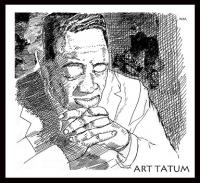
    The following article on Art Tatum appeared on December 27, 1999 in The Toledo Blade as part of the newspaper’s millennium series, which included articles on influential Toledoans during the century. Time-tested Tatum Toledo jazz pianist was the best there ever was By David Yonke - Blade Pop Music Writer "Art Tatum lived only 47 years, but his music will live forever and, according to many musicians and scholars, will never be equaled. “Any serious jazz pianist knows that Art Tatum is, and always will be, the greatest of all time. He will never be eclipsed,” said Benny Green, a New York-based pianist who records for the Blue Note label. “When you talk about the art of jazz piano,” said Jimmy Amadie, a pianist and educator from Philadelphia, “Art Tatum stands alone. His playing today would have been considered just as phenomenal as it was back then and, the thing is, a thousand years from now it will be just as phenomenal.” “He was the greatest soloist in jazz history, regardless of instrument,” Leonard Feather, the esteemed jazz critic, wrote in the liner notes of Tatum’s, “Piano Starts Here” CD. His admirers included George Gershwin, Vladimir Horowitz, Artur Rubinstein and virtually every jazz artist, including saxophonist Charlie “Bird” Parker, who once remarked: “I wish I could play like Tatum’s right hand!” Born Oct. 13, 1909, in a yellow, two-story frame house on Mill Street in South Toledo, near Dorr Street and City Park, he was all but blind from birth, with limited vision in his right eye only. His father, Arthur Tatum, Sr., was a guitarist and an elder at Grace Presbyterian Church, where his mother played piano. He lost most of his sight due to illness at age 3, but soon after began picking out tunes on the piano. He learned to read music in Braille and would entertain fellow pupils during recess at the Jefferson School. His piano teacher, Overton G. Rainey, recognized the youngster’s prodigious talent and tried to steer him into a career in classical music. Tatum, however, was more fascinated by the adventurous jazz piano of Fats Waller and James P. Johnson. And, as he knew all too well, in those days the prospects for African-American pianists in classical music were not exactly bountiful. Tatum played piano in Speed Web’s dance band and led his own group in concert at local venues such as Chateau La France and Chicken Charlie’s. At 17, he was featured playing interludes on WSPD radio, which were so popular the station gave him his own 15-minute program. Tatum moved to New York City in 1931, originally hired as an accompanist by singer Adelaide Hall. But he soon became a phenomenon on 52nd Street, which was lined with clubs featuring the jazz world’s greatest artists. “Tatum’s appearance on the jazz scene in the early ’30s upset all the standards for jazz pianists,” Feather, the jazz critic, once recalled. “His fantastic technique and original harmonic variations placed him incomparably far ahead of earlier artists.” Tatum made his mark immediately in a legendary “cutting contest,” where musicians try to outplay each other, in Harlem by playing a version of “Tiger Rag” that knocked Willie “The Lion” Smith and two of Tatum’s idols, Waller and Johnson, off the throne. One night Tatum walked into the Yacht Club on West 52nd Street while Waller was performing. After the song, Waller announced: “I just play the piano, but God is in the house tonight.” Not only did Tatum have the ability to play with blinding speed, sending cascades of solo notes flying from his right hand while brisk, sturdy chords resonated from the left, but he also played with stunning clarity, every note precisely articulated. And his improvisational skills were dazzling, taking brilliant new approaches to the same songs every time. “When I was 13 years old,” said Green, the 34-year-old jazz piano ace, “my parents bought me the reissues of the solo recordings that Tatum had recorded for [producer and record owner] Norman Granz. “As I listened to it, I knew that it was a monumental experience for me. .. On a superficial level, anyone can recognize his dexterity. But there’s so much more subtlety to Tatum’s playing. His harmonic palette was absolutely the most sophisticated ever. “He stands forever as a landmark, as a testament, to how beautiful this instrument can sound.” Jason Moran, a 24-year-old jazz pianist who recently made his debut as a band leader on Blue Note, said he has spent months transcribing Tatum’s piano solos, carefully recording every note and then trying to duplicate songs that Tatum played spontaneously. “The amazing thing about him, at least for me, is not only the incredible technique but the mind power that he put into the music,” Moran said. “To get past the notes and just to try to get into what he was thinking about, man, this guy was so inventive! He never played the same song the same way twice. "Technically, harmonically, rhythmically, in every sense of the word, he was a true artist and genius.” Claude Black, the veteran Toledo jazz pianist and member of The Murphy’s Trio, saw Tatum at Baker’s Keyboard Lounge in Detroit shortly before the jazz legend’s death in 1956. “Oh man, I thought he was just terrific. The best, I think, of anybody I ever heard,” Black said. He met Tatum after the show. “He seemed to be a quiet, laid-back person,” Black added. “He just sat there and talked.” Amadie, the Philadelphia jazz artist, said he was a teenage piano player when he went to see Tatum perform at the city’s Academy of Music in 1955. “I couldn’t believe it, I just couldn’t believe it,” Amadie said, his voice rising in excitement even 44 years later. “ I remember talking to three keyboard players at the time who also happened to see Tatum. One said, ‘I think I’m going to quit. I’m never going to play again.’ Another said, ‘I think I’m going to get a day job.’ The third said, ‘I also play a little drums. I think I’ll start concentrating on the drums.’ “I said, ‘I’ve been practicing seven or eight hours a day, I think I’m going to start playing 10 or 12.’ He motivated me. He’ll keep you humble. He’ll make you understand that you have to study the rest of your life.” “Anything you say about him is an understatement,” Green said. “To say he was an orchestra, to say he was the greatest solo pianist of all time, ultimately the music tells the tale. And his music is some of the most heavenly sounds I have ever heard or ever hope to hear in life.” As a musician, Tatum’s abilities were beyond question. But as with many of history’s greatest artists, his level of fame and fortune never rose to his level of artistic achievement. “How many frustrations Tatum had to suffer during his 46 years, none of us can ever quite know,” Feather once wrote. “He was black in a society that awarded honors to white musicians with a tenth of his talent. ... Beyond this was having come into jazz, his talent in full flower, during an era where there was no such thing as a jazz concert. During the peak creative years he was confined for the most part to small nightclubs.” Tatum died of kidney disease on Nov. 5, 1956 at age 47 in Los Angeles.
  24. Tjazz: Sent you an e-mail and a PM
×
×
  • Create New...