_forumlogo.png.a607ef20a6e0c299ab2aa6443aa1f32e.png)


Big Beat Steve
-
Posts
7,153 -
Joined
-
Last visited
Content Type
Profiles
Forums
Events
Blogs
Everything posted by Big Beat Steve
-
Am not familiar with the CD set, but to just to be able to follow the discussion somewhat: Could it be that this duplicates (in part) what was reissued on vinyl by Phontastic on the three volumes of "Count On The Coast" (PHONT 7546, 7555 and 7575, recorded 24 June to 3 July 1958)? Just curious because this is what I have with recordings from the Crescendo Club. Thanx.
-
A pretty heavy tome to just "pull it out" again. But interesting enough for repeated reading (piecemeal, of course) for anyone wishing to dive into the Swing Era through period writings. George T. Simon was clever enough to add comments and insights from the 70s (well after the fact) to set the occasional record straight. But I still feel it is most interesting to look at past eras like this through contemporary write-ups. Even though for the life of it I cannot quite understand Simon's obsession with certain demands on the musicians such as playing "tastefully" and "in tune". Not that this is all inappropriate but reading this in such a heavily packed way as in this book it at times this made me wonder what kind of bands really were dear to his heart anyway, and I do wonder how he did bring these criteria of his in line with post-1945 styles of jazz, starting with the honkers and bar walkers and some of the more uninhibited bebop acts through the Lionel Hampton concert caravans of the 50s and up to the freer forms of avantgarde (beyond Tristano and Giuffre).
-
Particularly if you can pick them up dirt cheap second (or third) hand ...
-
Pablo definitely was in the upper price brackets of jazz LPS over here in the 70s too, and they did look stark and austere in a "prestige" way to me. Maybe a bit like Mosaics came across later on (though of course the Pablos never were THAT upmarket). 70s latter-day recordings of 50s jazz heros were not my cuppa in the 70s and ealry 80s (student funds were limited and main preferences elsewhere) so I did not buy them in any quantities until quite a bit later but their price when new certainly had an effect too.
-
Interesting indeed and a matter of "one man's meat"... Probably a case of personal preferences and dislikes put into a "one-word-fits-all-pejoratives" package. Like "cute", for example ...
-
I got into Pablo sort of late but have caught up a little, and in all fairness, Pablos ARE recognizable (and today's Mosaic buyers should not be put off by those black covers with black B/W photographs anyway ). And while they may have been relatively cheap from an artist's angle (I'd not call them cheap but all too matter-of-factish), there were TONS of MUCH worse covers from that era. Particularly many, many from the 70s that were used to repackage reissues of earlier jazz recordings. Out of style, out of tune, out of phase, out of everything. Just apparently botched up to spare the 70s buyer the shock of having to look at covers with artwork that reflected the artwork style of the era that the music was recorded in (and of course often patched on the sleeve to lure the buyer into picking up an item that "looked recent" but repackaged reissues of older tracks). And often graphically cheap to boot ... Besides, at least IMO I cannot really see the JAZZ appeal all in those 70s/early 80s jazz covers that looked like they might just as much have been rock (prog, psych, even country rock, whatever ...) or soul/funk album covers of those years. Not something that would have really turned me on to them at first glimpse for its JAZZ content and certainly something that had to be "overcome" too. Might be OK for fusion sessions - but straight-ahead blowing jazz? And that might even have included some of the CTI covers I have seen here in this thread (not that I had been consciously aware of CTI bakc then ...). Just my 2c ...
-
Basie - Little Pony/NT Band Origins - What's The Real Story?
Big Beat Steve replied to JSngry's topic in Artists
I don't know about others, but I have always found the all too sharp distinctions between the OT and NT periods of the Basie band somewhat artificial and would certainly see the RCA period, for example, as a very direct continuation of the Columbia period and do not see a total break between them and the early Verves. Maybe also because I have listened to a lot to airshots and broadcasts, mainly from the 40s, and this makes you more aware of the gradual evolution that was happening. The boppish Basie recordings (including live ones) feat. Wardell Gray, for example, have long been a favorite too. What did initially strike me as "marching to a different drummer" were the Roulette recordings and it took me some time to warm up to them. But I have long since come to appreciate the Basie Roulette oeuvre and in fact listen to them more often than to the pre-Roulette Verve sessions, though for no specific reason that I would be able to pin down. Maybe it's the typical late 50s "bite" of these sessions that gets me at times? -
Basie - Little Pony/NT Band Origins - What's The Real Story?
Big Beat Steve replied to JSngry's topic in Artists
According to what Bruyninckx says about this 31/07/46 session, it looks like Stay On It was first released in the CBS days of Columbia. This is confirmed indirectly by the A-Bl volume of Jepsen's discopgraphy (published not long after 1962) which for obvious reasons does not list this tune at all (yet). -
Basie - Little Pony/NT Band Origins - What's The Real Story?
Big Beat Steve replied to JSngry's topic in Artists
I checked my copies of the Basic V-Discs recording reissues again - and those that are accessible online (Discogs etc.), but arranger credits are nowhere to be found for that 1944 version of Beaver Junction. But how about this?? https://guides.loc.gov/jazz-stock-arrangements/count-basie-published-parts Check the alphabetic listing ... Unless, of course, they mixed up the arranger credits with the 1951 re-recording of the tune. -
Basie - Little Pony/NT Band Origins - What's The Real Story?
Big Beat Steve replied to JSngry's topic in Artists
What I like better still about these promo pressings are the RCA promos that were on 78 but actually on VINYL. Example (while we're at it):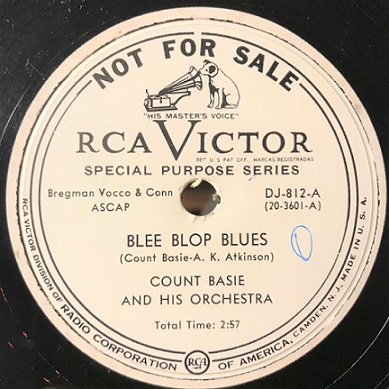
-
Basie - Little Pony/NT Band Origins - What's The Real Story?
Big Beat Steve replied to JSngry's topic in Artists
That would have been this pressing, then: https://www.discogs.com/de/release/12784483-Count-Basie-His-Orchestra-Little-Pony-Beaver-Junction -
Basie - Little Pony/NT Band Origins - What's The Real Story?
Big Beat Steve replied to JSngry's topic in Artists
See JSangrey's post at the top of this page. Little Pony and Beaver Junction were issued after the session, but the other two did not get a release until later in the vinyl era. -
Basie - Little Pony/NT Band Origins - What's The Real Story?
Big Beat Steve replied to JSngry's topic in Artists
Commonly accessible sources say this: John Chilton's "Who's Who of Jazz" says BH was a "prolific freelancer" a.o. for Basie following his staff arranger job for Cab Calloway in 1941/42. Brian Rust's "Jazz Records" lists "Rusty Dusty Blues" and "Ain't It The Truth" from the 27 July 1942 Columbia session as the first BH arrangements recorded commercially by the Basie band. This is confirmed by Vol. 5 of the Count Basie twofers in the French CBS Jazzotheque LP reissue series. If you need to pin down the time frame more accurately still (e.g. arrangements maybe done for the band for tunes only played on-stage or on airshots), maybe your jazz scribe friends (who should/might have more access to source material) can help out? -
Jazz Pop Smash Hits of the 1950s and 1960s
Big Beat Steve replied to Rabshakeh's topic in Miscellaneous Music
Yes I realize this perspective was bound to be quite different over here because he had made jazz recordings from late 1956. And some of these records were popular (relatively speaking) to the extent that you even stood a chance in later decades of finding an occasional EP at fleamarkets. Re- all, and Re-Eddie Harris' "Exodus" and similar 45 pop hits from the jazz field, how about Ray Bryant - "Madison Time"? It must have been big enough over here to remain in print as a 45 from the time Philips handled Columbia in Europe until the time everthing on Columbia became CBS. -
Jazz Pop Smash Hits of the 1950s and 1960s
Big Beat Steve replied to Rabshakeh's topic in Miscellaneous Music
Yes, that one too. But as I recollect this was more seen as "former jazzman Jankowski has gone pop now" over here and much less so as a jazz tune that has made it into the pop charts. Rather like someone aiming at the Bert Kaempfert clientele ... But of course in the end that's a matter of taste and of where you set your boundaries of jazz. -
Jazz Pop Smash Hits of the 1950s and 1960s
Big Beat Steve replied to Rabshakeh's topic in Miscellaneous Music
Make that Swingle SINGERS please, anyway! (The late Ward Lamar says thanx! ) As for the other examples you name, I am not so sure the Frankie Laine/Buck Clayton LP was suich a smash hit at the time ... IMO the Les Elgart example you name would be in quite a different league from what you see others have named in their posts to this thread. More an example of the latter-day big bands of jazz/swing-cum-pop in the 50s and early 60s, of which there were quite a few. The Buddy Morrow big band must have had bigger sales with "Night Train" that Jimmy Forrest did with his original (or other R&B covers did). AFAIK other big bands of that kind included Jerry Fielding, Ralph Marterie and Ralph Flanagan, for example. Other jazz tunes that the "normie consumers" were exposed to should also include the jazz signature tunes to certain radio (or TV?) shows that must at least have "softened" the attitude of some listeners towards jazz. One that was big here on radio in Southern Germany for a LONG time was Horst Jankowski's version of the Basie tune "Cute" - recorded in 1961 for Metronome and used regularly on the SDR radio at least until the mid-70s as the signature tune for regular live broadcasts (including concerts beyond jazz) from the radio station concert hall. BTW, as for Britain, how about some of the "jazz-adjacent" recordings of the Basil Kirchin Band during that period? Or Ray Ellington or some of the Tony Crombie recordings (not including his own take on R'n'R here)? I understand they made an impact in the pop market too? -
Basie - Little Pony/NT Band Origins - What's The Real Story?
Big Beat Steve replied to JSngry's topic in Artists
Don't tell me I almost nailed the orignal text with my retranslation of the French translation back into English ... Almost too much of a coincidence As for the rest of your quote, I must admit I missed that (it's three pages on in the French book, with 2 pages of photographs in between). It certainly does correct the history of the relaunch of the big band stated elsewhere. As for the Little pony session of 10 April 1951, the French reissue twofer (Vol.6 of the Columbia Basie reissues in the Jazzotheque series, CBS 88675) names Neal Hefti as the arranger for Little Pony and Buster Harding for the other three tunes. Amazing if these credits weren't indicated on other LP reissues too. -
Getting back to your original question, you might want to check this (print-on-demand, it seems) book too, as it also includes his sideman dates. https://bearmanor-digital.myshopify.com/products/flights-of-the-vout-bug-a-guide-to-the-recorded-music-of-michael-dodo-marmarosa-by-dieter-salemann-fabian-grob The layout (of my copy at least) is a bit strange as the margins on the pages are oddly wide, making the actual contents per page unnecessarily small. It is not a full-blown biography and texts are relatively brief but the comments on each session betray the "zealous collector" compilers. As for Dodo Marmarosa releases on Uptown, this one (below) is worth exploring too: https://www.discogs.com/de/release/5921927-Dodo-Marmarosa-Pittsburgh-1958
-
Basie - Little Pony/NT Band Origins - What's The Real Story?
Big Beat Steve replied to JSngry's topic in Artists
That's about what Alun Morgan said in the Basie bio mentioned earlier too, referring to Stanley Dance as his source. He also hinted at Basie being a penny pincher when it came to salaries and granting a raise and not being as close to his sidemen as he was later on. So maybe money was a factor in the changes of personnel too? -
Basie - Little Pony/NT Band Origins - What's The Real Story?
Big Beat Steve replied to JSngry's topic in Artists
I will have to check later. But it is not a "fat" biography but rather one that was published as part of a series of books on various jazz stars. So certainly not comprehensive. -
Basie - Little Pony/NT Band Origins - What's The Real Story?
Big Beat Steve replied to JSngry's topic in Artists
Acording to the reissue I have (on Vol. 6 of the French CBS Basie twofers in the Jazzotheque series) the big band session that included Little Pony happened on 10 April 1951. The previous (Octet) commercial recordings by the Basie band had taken place 16 May, 2 Nov. and 3 Nov. 1950. To find out more, I leafed through the "Count Basie" bio by Alun Morgan published in the 80s (my quote is not verbatim because I have the French edition published by Garancière in 1986; the English orignal under the same title had been published by Spellmount in the UK in 1984), and lo and behold, I immediately came across this: "In January, 1951, De Franco quit the sextet to form his own group and was replaced by Rudy Rutherford. Then, in April, Basie had an opportunity of getting a big band of 16 men together for a one-week engagement at the Apollo Theater. He lost no time in getting his new band into the Columbia studios to wax his first big band sides since August, 1949, including a splendid version of 'Little Pony'. Neal Hefti, who wrote arrangements for the sextet with Buddy De Franco, also contributed charts for the session that included heavyweights such as Al Porcino (tp) and Marshall Royal (as). Unfortunately the big band was unable to round up follow-up bookings and therefore Basie was forced to return to the "small band" formula." Possible historical inaccuracies (that may have been pointed out elsewhere - who knows?) aside, this should provide the gist of an answer. For the record (literally ...), the next recordings that Bruyninckx lists after the Columbia session of 10 April 1951 are an "All Stars" (septet) New York broadcast on 20 April 1951 issued on the Giants of jazz and Swing House labels, another septet session from a broadcast on 28 April 1951 released on Ozone and Moon (CD), and then there is a BIG BAND (16 men) boradcast from New York on 6 May 1951 that has remained largely unissued (as of the time of the Bruyninckx publication). Only 2 of the titles were issued on obscure collector labels. Next came the Clef recordings by the big band on 17 Janury 1952. So in April and May, 1951, there seems to have been to and fro between Basie small groups and a big band. -
Yes, hilarious. Because it does reflect sounds you've heard on the radio. Though there is another angle to it that I am wondering about ... I am not familiar with today's female U.S. pop singers so cannot pinpoint who she is actually making fun of but her first segment, in particular, made me think of others that may be more present over here: Over time there seems to have been a tendency of British singers not so sing in what might be construed as "standard" or "universally understandable" English but to show off (or fake?) a marked Irish, Scottish or Welsh accent (or one from some of the more outlying regions of England?). And when you combine the slurs and off pronounciation of her first segment you end up with how some of these female singers really do sound like.
-
Jazz Monthly
Big Beat Steve replied to Quasimado's topic in Jazz In Print - Periodicals, Books, Newspapers, etc...
I can understand that too but IMO there remains a huge problem because 1) far from all "good music" gets reviewed so nobody knows for sure what kind of indicator a non-review actually is, and 2) if only treacherously good or near-good reviews are published this in the long run is likely to reek of "do not offend the advertisers and/or freebie CD providers" courtesy reviews at least to part of the readership. Which might backfire against those who publish them (at least with some readers) ... -
Jazz Monthly
Big Beat Steve replied to Quasimado's topic in Jazz In Print - Periodicals, Books, Newspapers, etc...
Strangely enough, this seems to be true for other areas of specialist music journalism too today. I've noticed this in certain rock and Metal magazines (that I once or twice glanced at in my son's room). And a friend of mine runs a very "home-made" fanzine for today's rockabilly (and closely related musical styles) subculture, and although far from all is gold that glitters in record releases even within this subculture I found that he seems to shy away from voicing his dislikes in print. I know him well emough to know he has strong opinions (that usually do have a valid point), but his record revies are nowhere near this level. I once asked him and to my surprise he was sort of evasive, stating that he simply does not review what he doesn't like. So I guess his reviews to the tune of "not really my cuppa but to each his own" must be considered a one-star tear-up and write-down. And this although his fanzine does not have commercial considerations with powerful advertisers. But loyalty with anyone who gets something going within the subculture (even in the case of those of their items that - fairly objectively speaking - are turds) seems to be the thing to do throughout. Pity ... -
Jazz Monthly
Big Beat Steve replied to Quasimado's topic in Jazz In Print - Periodicals, Books, Newspapers, etc...
The latter is one name that can easily be confused with another one among scribes from that era: Steve Race. From what I have seen by and particularly about him and regardless of what he apprently did himself later from the 60s onwards, he was a consistent pain in the butt for many on the trad/skiffle/rock side of the British music business once R'n'R started to gain a foothold there in the 50s.