_forumlogo.png.a607ef20a6e0c299ab2aa6443aa1f32e.png)
All Activity
- Past hour
-
Impressive!
-
- Today
-
- Yesterday
-
Copykitten.
-
-
Coming soon from Monolithic Music Group: Her debut album, "Hot Cross Jazz."
-
With Elevator Songs, the first collaboration between multi-Grammy-winning vocal group Roomful of Teeth and singer-songwriter/composer Gabriel Kahane, the laws of time and space give way to pure feeling. Here is an album in which fizzy hooks, slippery chord changes, and the sublime counterpoint of eight voices combine to create a singular, panoramic vision. With each song—one for each member of Roomful of Teeth and bookended by a pair of tunes sung by Kahane, who wrote and arranged the entire work—a distinct world emerges in a series of hotel rooms: here, a newlywed undone by the sublime topography of the American Southwest; there, a man in midtown Manhattan writing a eulogy for a young AIDS victim in the late 1980s; here again, a fashion influencer slash spiritual guru recording a podcast episode in a militarized, near-future Texas; there again, a U.S. service member confronting PTSD after tours of Iraq and Afghanistan in the mid-aught. Taken as a whole, the LP is as emotionally enveloping as it is sonically diverse Thick voices are one of my favorite places in which to become lost.
-
-
-
S
-
-
Doug was very supportive of me in Night Lights' first several years on the air and appears on several shows, including programs about Paul Desmond, Willis Conover, and Vince Guaraldi. His Desmond bio is a work of art. And in the 2000s, long before Substack, Reddit etc, his Rifftides was one of the best jazz blogs going. Sad news, but he leaves lots of good writing behind him.
-
 I wonder if we'll ever get another volume of Dan's writings (unlikely, I'd imagine, especially now that he's departed). Living With Jazz was an excellent anthology and covered a lot of ground, but this thread is a reminder of how much uncollected work is still out there.
 -
Three games today https://cflnewshub.com/cfl-news/cfl-preseason-today-23-three-games-close-week-2-tv-channels-live-stream-odds ***** Toronto - Hamilton https://www.cfl.ca/2026/05/15/preseason-week-2-toronto-argonauts-at-hamilton-tiger-cats-3/ ***** Edmonton - BC https://www.cfl.ca/2026/05/15/preseason-week-2-edmonton-elks-at-bc-lions/ https://cflnewshub.com/cfl-news/bc-lions-preseason-game-1-preview-vs-edmonton-elks-prediction-keys-game-depth-chart ***** Winnipeg - Sask https://www.cfl.ca/2026/05/15/preseason-week-2-winnipeg-blue-bombers-at-saskatchewan-roughriders/ https://pifflespodcast.com/blog/game-day-saskatoon-shines-with-first-riders-preseason-game-in-35-years/ ***** Winnipeg analysis https://cflnewshub.com/cfl-news/i-expect-bombers-offence-better-2026 ***** Highest-Paid kicking team members https://3downnation.com/2026/05/23/the-cfls-highest-paid-specialists-in-2026/ ***** Ottawa - Montreal reviews https://3downnation.com/2026/05/23/big-scare-slow-start-fells-alouettes-in-cfl-preseason-loss-to-redblacks-and-five-other-thoughts/ https://3downnation.com/2026/05/23/redblacks-get-strong-quarterback-play-and-other-thoughts-on-ottawas-preseason-win-in-montreal/ https://3downnation.com/2026/05/22/alouettes-qb-davis-alexander-pulled-from-preseason-for-precautionary-reasons-still-expected-to-start-week-1/
-
They are paper sleeve and they are hybrid (I believe, have not tried the redbook layer). I imagine the same mastering is on the UHQCD versions previously released remastered by Kevin Gray in the case of the two Blue Notes and the Tone Poet in the case of Birth of the Cool--and perhaps that UHQCD, I don't see who mastered that one.
-
 I really appreciate bringing these liner notes to our attention. I learned a lot about Stuff from them.
 -
What Jim said!
-
-

What Classical Music Are You Listening To?
Peter Friedman replied to StarThrower's topic in Classical Discussion

-
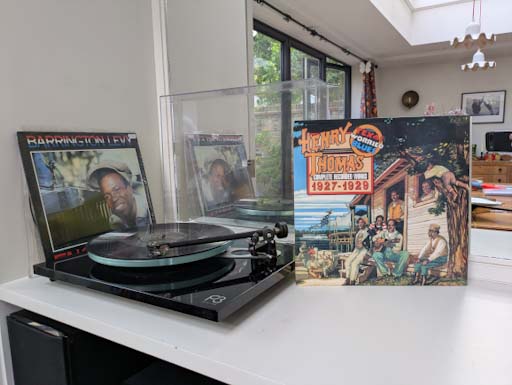
Henry Thomas – Texas Worried Blues (Complete Recorded Works 1927-1929)
-
Well I'll be damned!
-
 Offered for sale is a great Mosaic box set, The Complete Blue Note Recordings of Sidney Bechet. This is the rare 6 LP box set. Sidney Bechet - The Complete Blue Note Recordings of Sidney Bechet 6 LP, Mosaic, 1985 Limited Edition of 7500 copies (this is copy # 0764). Outer box: The outer box is in VG condition. It has a half-inch horizontal tear to mid right side of the front cover of the outer box. There is also some shelf wear to edges/corners of the outer box. And, as is unfortunately uncommon with these older type of Mosaic boxes, the black spinal tape is torn the length of the spine and the front outer box panel is loose from the rear outer box panel. But the silver spinal lettering is still nice and sharp. Vinyl: The 6 records are in VG+ condition. All are nice and flat and play fine. Booklet: The booklet is in nice shape. $62 (+ $8 media mail shipping). Pay pal friends/family. U.S. shipping only
 -
Thanks for the tip! I just ordered these. It doesn’t say they are paper sleeve but that’s a bonus for me! Also, it’s says they are sacd only, so are they actually hybrids? I also preordered these 2 sacd “Kind of Blue” in stereo and mono. Looked interesting.
-
Cadence Magazine Newsletter Friends, the Hampel family needs our help. If you knew Gunter, worked with him, listened to his music and appreciated his example as an independent self-implementing artist, we hope that you will find a way to make a contribution. Help spread the word by sharing this post! Notes from the family: “Ever the maverick, Gunter was uninsured and spent the last ten years of his life battling COVID and cancer, which led to six figures of hospital debt. His family now faces substantial medical bills from Berlin and Göttingen hospitals and clinics, along with funeral and memorial costs. Despite these challenges, Gunter’s legacy continues to inspire musicians and fans worldwide. We invite you to support Gunter’s family as they honor his memory and contributions to music and art. Please stay connected as we plan for his June funeral and August memorial. We appreciate Gunter’s worldwide fans and look forward to sharing his music and memorabilia in the near future.” @ruomileehampel https://www.gofundme.com/f/honoring-gunter-hampels-legacy