_forumlogo.png.a607ef20a6e0c299ab2aa6443aa1f32e.png)

John L
-
Posts
4,459 -
Joined
-
Last visited
Content Type
Profiles
Forums
Events
Blogs
Everything posted by John L
-
"Out of Sight" from 1964 was already at least a mini explosion.
-
I only have the Tradition CD that is entitled "Running Wild." That sound is OK but I have never heard the other alternatives. The Tradition CD only has 11 tracks. So I assume that it is therefore inferior to the other options.
-
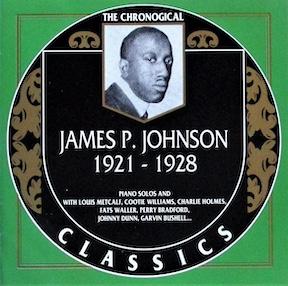
Probably Chronological Classics. One disc has his recordings from 1921-1928. Another disc goes from 1928-1938. if you are also interested in the piano rolls, Tradition had a disc that contained them.
-
Probably the worst liner notes I ever read were from Robert Levin for Shirley Scott's "The Soul is Willing" that features Stanley Turrentine. The notes begin with the stupid line that "All jazz, directly or indirectly, has come out of Harlem," and go steeply down hill from there. ..."it must be said that it [the music] has obvious limitations...The limitations of the music result from the limitations of the community from which the music comes. Harlem is, after all, a ghetto, and many sources are not easily accessible to it. The art it produces is one where the controlling emotion is frequently anger..." etc., etc. etc. It amazes me that Prestige would have permitted this kind of garbage to be put on one of its records.
-
Thanks. That was nice. I wonder what Thelonious would have thought of it? NRBQ has consistently been one of the most interesting rock bands (IMO).
-
It was great to have him with us for so long. RIP
-
I have the Masters of Jazz disc. Irakli de Davrichewy wrote the liner notes and takes credit for redating the Paramount session from December to September. His logic is that, first, Paramount matrix numbers often did not follow the chronological sequence of when music was recorded and, second, by the December date, several of the musicians present at the session had already left the band and were replaced by other musicians. Curiously, he does not state in the text exactly which musicians but cites supporting evidence as being from a Preston Jackson interview in the November 1942 Down Beat and a quote of Johnny St. Cyr in the December 1948 Jazz Finder. He entertains the idea that Oliver could have brought the musicians back just for this session but believes that to be highly improbable. The month of September just seems to be a guess as a likely time in his view.
-
And don't forget to listen to some prime Louis Jordan, as well as Wynonie Harris, Big Joe Turner, Roy Brown, and Little Willie John.
-
 If I could have only one blues disc, it would be disc 2 of this one.
 -
Luciano - The Jazz Up release is indeed incomplete. I have it. Parkeriana cuts out in the middle of Johnny Coles' solo on that CD. Landscape issues a lot more music from the concert on 2 CDs, including Meditations that is not on Jazz Up.
-
Luciano - Your confusion is understandable. As Romualdo's posting of the discography above shows, there were two different Paris concerts. Both of them were recorded. Different CD and LP packages have released various mixes of these tracks, and some packages include tracks from both of the two different concerts. The discography above should help you sort out which tracks are where. Johnny Coles only played on So Long Eric in the first concert. He became sick and missed the rest of the tour.
-
To each his own, I guess. For me, it is just the opposite. I like the sound on the set with Mobley just fine. But I do not like the sound on "Meet You.." at all. I am far from an audiophile but I actually avoid listening to "Meet You..." because of the sound.
-
You're gonna dig it. That new 1951 recording is a never-ending blast!
-
RIP. I was somehow sure that he would make it to 100. What a career !
-
RIP!
-
RIP. His impact on American music. was huge.
-
Yes, I think that the mention of the Design label by Bob Blumenthal was just a mistake. Bud recorded during that period for only Morgan/Verve and RCA.
-
Miles Davis — May 26, 1958 session (pre-KOB, with the KOB line-up)
John L replied to Rooster_Ties's topic in Discography
This is the only studio session made by Miles when Bill Evans was still an actual member of the band. For Kind of Blue, Miles called Evans back just for the recording session. There are the live dates with Evans in the band as well. -
Classic V-Disc Small Group Jazz #279 – 11 CDs
John L replied to Hardbopjazz's topic in Mosaic and other box sets...
I have been really enjoying the first Red Norvo session here with Mildred Bailey. It reminds me that I need to listen to them more often. -
Classic V-Disc Small Group Jazz #279 – 11 CDs
John L replied to Hardbopjazz's topic in Mosaic and other box sets...
I entered all of the data myself for all 11 discs. It used to be easy to convey that information to the database. But I don't see how to do it anymore. -
Classic V-Disc Small Group Jazz #279 – 11 CDs
John L replied to Hardbopjazz's topic in Mosaic and other box sets...
There are actually many other examples of tracks included that were never released as V-Discs. I suspect now that the Fats Waller omission might be due to the fact that the masters for these tracks are apparently missing. -
Classic V-Disc Small Group Jazz #279 – 11 CDs
John L replied to Hardbopjazz's topic in Mosaic and other box sets...
OK. I guess that I had assumed that unissued tracks were omitted only if the music was lost. But the Fats Waller case is a counterexample to that. By the way, they include Stealin' Apples in the box from a Peanuts Hucko session of May 14, 1947 from which no V-Discs were issued. So that would seem to be a counterexample to your hypothesis as well., -
Classic V-Disc Small Group Jazz #279 – 11 CDs
John L replied to Hardbopjazz's topic in Mosaic and other box sets...
Lon - I didn't understand that as the logic. There are actually a lot of tracks on this set recorded at V-Disc sessions that were never issued on V-Disc. I am certainly not disputing their claim that "Silvery Moon" came from a radio broadcast. -
Classic V-Disc Small Group Jazz #279 – 11 CDs
John L replied to Hardbopjazz's topic in Mosaic and other box sets...
I have always really loved the Fats Waller V-Disc Session. But I was a bit disappointed that Mosaic left off 3 tracks from this session: The Ladies Who Sing With the Band, To A Wild Rose / Don't Get Along Anymore, and St. Louis Blues. The Mosaic discography correctly lists them as "unissued" by V-Disc. But they have appeared on other releases, including the JSP complete Fats Waller series. Mosaic also omitted another track commonly thought to be from this session, By the Light of the Silvery Moon, claiming that the track actually comes from a radio broadcast. -
RIP. She was a legend in the East Bay where I grew up.